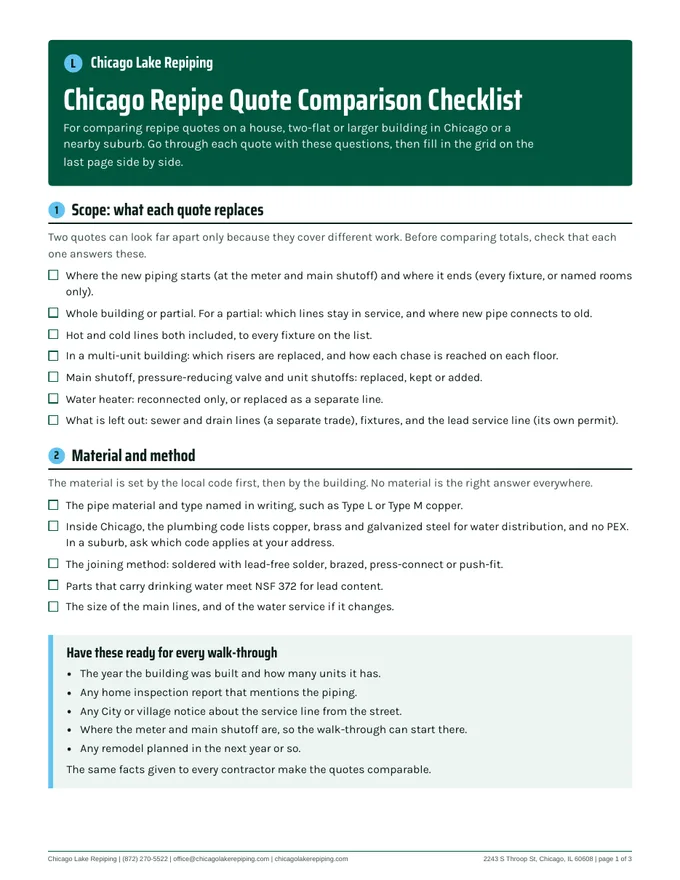
What the checklist covers
The same questions as the printable, so you can read them here first. Quotes that look far apart can turn out to cover different work, and these questions show where.
Scope: what each quote replaces
Two quotes can look far apart only because they cover different work. Before comparing totals, check that each one answers these.
- Where the new piping starts (at the meter and main shutoff) and where it ends (every fixture, or named rooms only).
- Whole building or partial. For a partial: which lines stay in service, and where new pipe connects to old.
- Hot and cold lines both included, to every fixture on the list.
- In a multi-unit building: which risers are replaced, and how each chase is reached on each floor.
- Main shutoff, pressure-reducing valve and unit shutoffs: replaced, kept or added.
- Water heater: reconnected only, or replaced as a separate line.
- What is left out: sewer and drain lines (a separate trade), fixtures, and the lead service line (its own permit).
Material and method
The material is set by the local code first, then by the building. No material is the right answer everywhere.
- The pipe material and type named in writing, such as Type L or Type M copper.
- Inside Chicago, the plumbing code lists copper, brass and galvanized steel for water distribution, and no PEX. In a suburb, ask which code applies at your address.
- The joining method: soldered with lead-free solder, brazed, press-connect or push-fit.
- Parts that carry drinking water meet NSF 372 for lead content.
- The size of the main lines, and of the water service if it changes.
Permit, license and inspection
In Chicago, a permit is required to replace water piping, and the work is done by a Chicago-licensed plumbing contractor.
- Who pulls the permit, and which kind: an Express Permit for replacing what is there, or plan review if the layout changes.
- The permit fee shown as its own line, not folded into the total.
- A separate water permit if the meter or the service line is touched.
- The contractor's Chicago plumbing contractor license number for work in the city, and a certificate of insurance.
- For a condo: the association letter. For riser work: the full-riser drawing.
- Who schedules the inspection, and who will be there for it.
Walls, floors and restoration
Openings and patching are easy to leave vague in a quote. Ask for them in writing.
- How many openings, and in which rooms.
- How plaster is opened (clean rectangles at fittings and turns) and whether tile walls are reached from the back.
- Who closes the openings, and to what finish: patched only, patched and textured, or painted.
- How floors, furniture and common areas are protected.
- Where old pipe stays in the walls, disconnected.
Schedule and water
Living through a repipe depends on two things: how many working days, and when the water is off.
- The number of working days.
- The water-off windows. Water should be off only while each part is cut over.
- In an occupied multi-unit building: which unit is without water and when, and how the people living there are told.
Testing and handover
These steps are what make the new piping trustworthy before the walls close.
- A pressure test before any wall is closed.
- Flushing after cutover, with aerators and screens cleaned.
- Shutoffs labeled.
- The final inspection sign-off and a copy of the permit for your records.
- Any written warranty: what it covers, for how long, and who honors it.
- The payment schedule, tied to stages of the work.
The side-by-side grid
The last page is a grid with one column per quote. A blank box is a question to ask before signing.
- Contractor and license number
- Material, type and joining method
- Starts at / ends at
- Whole or partial; what old pipe stays
- Risers, main shutoff, PRV
- Openings, and who closes them
- Permit type, and who pulls it
- Working days
- Water-off windows
- Pressure test and inspection
- Not included
- Total quoted
Have these ready for every walk-through
- The year the building was built and how many units it has.
- Any home inspection report that mentions the piping.
- Any City or village notice about the service line from the street.
- Where the meter and main shutoff are, so the walk-through can start there.
- Any remodel planned in the next year or so.
Giving every contractor the same facts is what makes the quotes comparable.
Get the printable checklist
Send the short form and the download link appears right under it. If you would like a walk-through as well, say so in the message.
Call (872) 270-5522Chicago Lake Repiping2243 S Throop St, Chicago, IL 60608
office@chicagolakerepiping.com