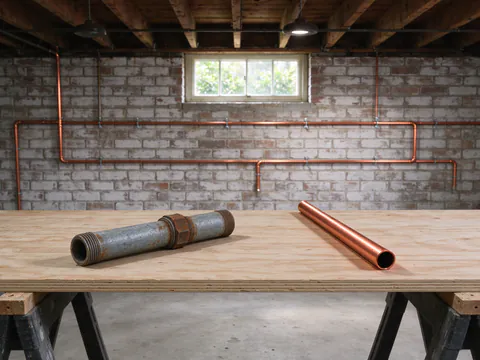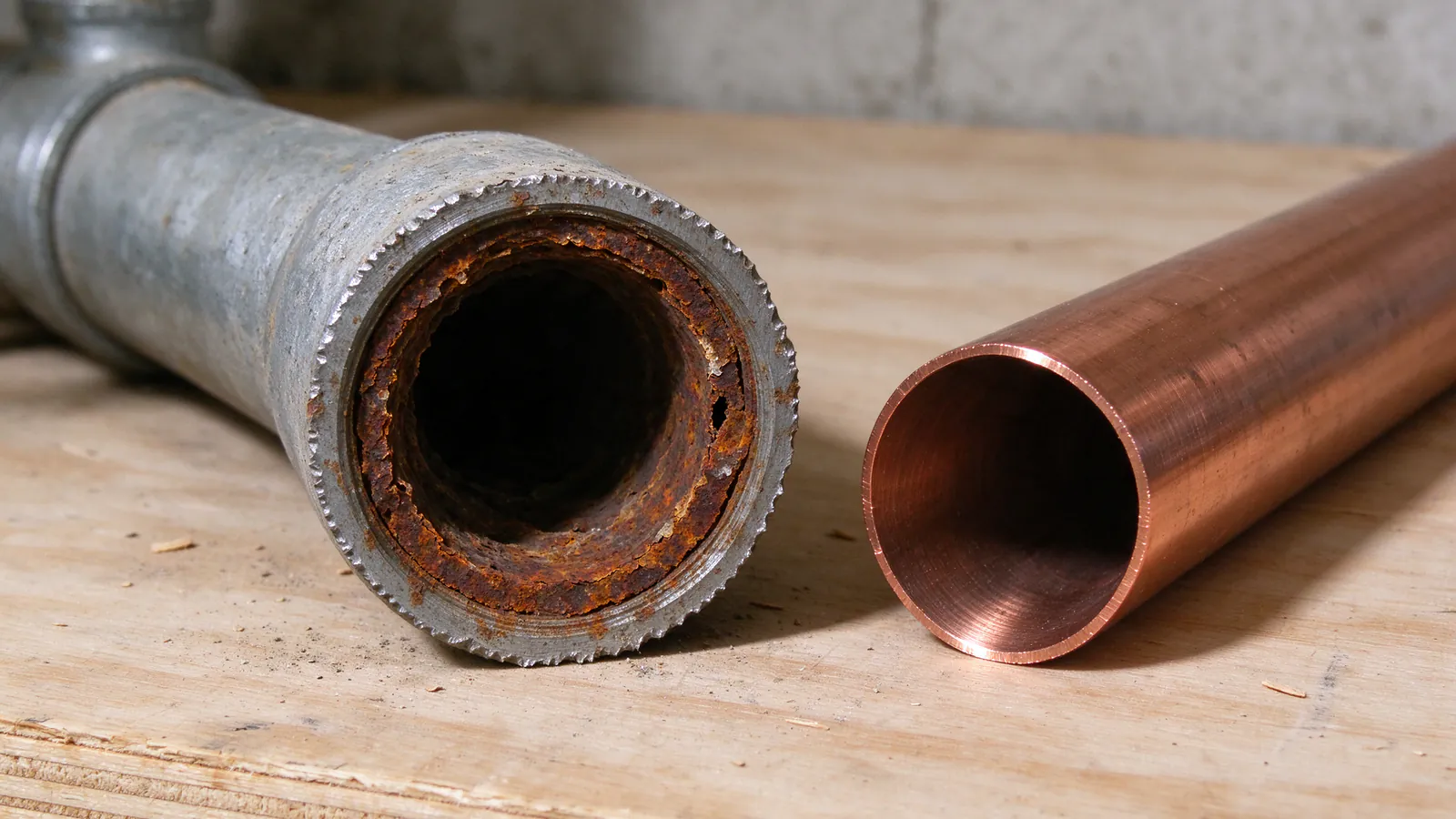
If a Chicago house still has galvanized steel water pipe, it is corroding from the inside, and the question is when to replace it, not whether it will hold forever. Inside the city, the replacement is copper, under a City permit, done by a Chicago-licensed plumbing contractor. Low pressure or rusty water point toward galvanized, but the service line, valves and water heater can cause the same symptoms.
This guide walks through the whole decision for an older Chicago home: identifying the pipe, reading its symptoms, sorting out the lead labels, the code and the permit, and planning the work in a bungalow or a two-flat. Chicago Lake Repiping offers and manages galvanized pipe replacement and whole-house repiping across Chicago and nearby Cook County suburbs, with the work done by licensed and insured plumbing contractors.
How to tell if you have galvanized pipe
The best place to look is the basement, where the water line comes through the foundation wall and meets the meter and the main shutoff. From there, follow the pipe that leaves the meter toward the water heater and up toward the floors above.
Galvanized steel pipe is a dull silver-gray, with threaded joints: the fittings screw onto the pipe, and you can see the threads at the edge of each elbow or tee. A refrigerator magnet sticks to it firmly. Copper is reddish brown, or dark brown to green where it has aged, with smooth soldered or pressed joints, and a magnet does not stick. Lead pipe, which in Chicago turns up on service lines and sometimes inside older homes, is also dull gray but is soft and not magnetic; scratching it lightly with a key shows shiny silver metal, and it can show a rounded bulge where it was joined. That scratch test belongs on the service line where it enters the house, not on anything under strain.
Old houses mix materials. A copper line from a past bathroom remodel can feed into galvanized risers, or a section of copper can sit between two runs of steel where someone fixed a leak. Check the pipe at the water heater, under the kitchen sink and at the laundry, not only at the meter. Where a dielectric union or brass fitting sits between copper and steel, someone has already dealt with the transition. The guide to identifying your water pipes has photos of each material and the joints between them.
If the pipe is gray plastic: polybutylene
How to recognize polybutylene
Polybutylene is a flexible plastic water pipe, gray on the indoor lines it is known for, and it may carry a code such as PB2110 printed along its side. The joints give it away: plastic or metal insert fittings held by crimp rings of copper or aluminum. A magnet does not stick, and there are none of the threads of galvanized steel or the soldered joints of copper. PEX uses crimp rings too, but PEX is white, red or blue and printed with “PEX”, so read the printing before deciding.
Polybutylene is not on Chicago’s list of water distribution materials in Table 18-29-605.5, and Park Ridge’s code bars it by name. No local data shows how much of it remains in Chicago-area houses, so finding a section of it says something about that house, not the block. Where it turns up, a past repair or remodel is the place to start asking.
Replacing polybutylene
Polybutylene is associated with failure concerns that trade explanations tie to the disinfectants in treated water working on the plastic and its fittings from the inside. A section can look sound and still be weakened, and no visual check shows how far along it is. That uncertainty is the argument for replacing it on a schedule rather than after a leak.
Inside Chicago, the replacement is copper under a City plumbing permit. If the polybutylene is one spliced section, a partial repipe takes it out back to sound pipe; if it feeds the whole house, the whole-house repiping scope applies. In the suburbs the material follows the local code, which the guide to PEX in Chicago lays out town by town, confirmed per address before work starts.
How galvanized pipe fails
Galvanized pipe is steel coated with zinc. The zinc slows corrosion while it lasts, but it wears through from the water side, and the steel underneath rusts. Rust and mineral scale build up on the inside wall in rough lumps, so the opening the water flows through gets smaller every year. A half-inch line can lose much of its working bore before anything shows outside.
That is why galvanized gives itself away through flow first. The upstairs shower drops when someone opens the kitchen tap. Filling a tub takes longer than it used to. The far fixtures, highest in the house and furthest from the meter, feel it before the basement laundry does. Hot water lines can narrow faster than cold, because warm water speeds the reaction, so a house where the hot side runs weak and the cold side seems fine is still telling you something about the pipe.
The threaded joints are the weak points. Cutting threads removes part of the pipe wall, so the thinnest steel in the system sits exactly where two pieces meet. Leaks can start there first, and a joint that has rusted tight can crack the next fitting when a plumber tries to turn it. Homeowners report that plumbers are reluctant to repair or warranty small fixes on galvanized lines for that reason, which is one way a single drip becomes a conversation about the whole system.
Repairs can also stir things up. When a section is cut, or when the water is shut off and turned back on, rust flakes loosen and travel downstream. Clogged faucet aerators, a toilet fill valve that sticks and a sudden burst of brown water after plumbing work are all signs of scale moving through old pipe.
Rusty water or low pressure: what else could it be?
Neither symptom proves the cause by itself. The order in which the possibilities are ruled out matters, because each one points to a different fix.
Brown water. If only the hot taps run rusty, the water heater is a suspect: an old tank can shed rust and sediment of its own. If every tap runs brown for a few minutes and then clears, think about work on the street: hydrant flushing or a water main project can stir sediment in the City’s lines. If the first draw of the morning is brown at certain fixtures and the color returns after the water sits, the pipe feeding those fixtures is the likelier source. The rusty water guide goes through each pattern.
Low pressure. Start with static pressure, read at a hose bibb or test point with nothing running, then compare flow at the lowest and highest fixtures with two taps open. Good static pressure with poor flow upstairs points at the piping. Low static pressure points upstream: the service line, the valve at the meter, a pressure-reducing valve that has failed partly closed, or the street. Chicago’s updated code calls for a pressure-reducing valve where static pressure runs above 80 psi, mandatory for permit applications from December 1, 2026, so a valve may be present on a building that has had recent work.
The service line bottleneck. The buried line from the street is part of the path. Homeowners report repiping the inside of a house and finding the pressure unchanged, because the old service line was the restriction all along. Chicago’s code sets a minimum water service of 1 inch for new work, and a lead or galvanized line from decades ago can be smaller and narrowed inside. When the service line is the problem, it is a separate project with its own water permit, covered in lead service line replacement. The low water pressure guide for older Chicago houses covers the test sequence.
Fixtures. One weak faucet with everything else normal is less likely to be a piping problem: a clogged aerator, a worn cartridge or a corroded stop valve under the sink can choke a single fixture. Clean or check those first.
Galvanized and lead: what “galvanized requiring replacement” means
Chicago’s lead story is mostly about service lines, the pipes that run from the water main under the street into each building. Lead-Safe Chicago, the City’s lead program, says those lines were primarily made of lead until the federal ban in 1986, and that a house or two-flat built before 1986 has a high likelihood of a lead service line unless it was replaced during a renovation or an addition.
The City’s service line inventory sorts addresses into lead, suspected lead, galvanized requiring replacement and non-lead. The galvanized category exists because lead can collect inside galvanized pipe. A galvanized service line that is or may have been connected downstream of lead is treated as needing replacement, since the rough rust on its inside wall can hold lead particles and release them later. A public analysis of the City’s inventory by Grist and Inside Climate News estimated that about 84% of service lines citywide are confirmed or suspected to contain lead. The guide to the galvanized requiring replacement label explains how to read your address’s listing.
Keep two things apart. The inventory label describes the service line, the pipe outside the foundation and up to the meter. Interior galvanized supply pipe is a separate system, and the City’s programs do not cover it: the City’s Breaks and Leaks program, for example, excludes interior piping more than two feet from where the service enters the house. A home can have a new copper service line and galvanized pipe everywhere inside, or the other way around.
Chicago treats its Lake Michigan water with corrosion control that coats the inside of pipes to reduce lead and copper leaching. That lowers risk but does not remove it, and a water test is the way to know what reaches your tap.
Why there is no PEX inside Chicago
The Chicago Plumbing Code, Chapter 18-29 of the Municipal Code, lists the materials allowed for water distribution in Table 18-29-605.5: brass pipe, copper and copper-alloy pipe and tubing, and galvanized steel pipe. CPVC, polypropylene and PVDF appear only with a note limiting them to secondary water used in process applications. Cross-linked polyethylene, PEX, is not on the table at all, and the code requires new and replaced water supply pipe to be of the listed materials. Galvanized steel is still listed, but it is not a practical choice for new work; copper is.
The City has loosened the code for plastic before, but not for drinking water. Its 2021 interim amendments, which followed a four-year study of alternative materials, expanded the use of PVC for drain, waste and vent pipe in low- and mid-rise residential buildings. They did not add a plastic water distribution pipe. The City’s own permit records reflect it: one Easy Permit from 2022 reads “correct plumbing code violations, replace PEX piping with new copper pipes,” and no permit describing a new PEX or CPVC water distribution system turned up in a search of the City’s permit data.
Homeowners report waiting on a rule change that would allow PEX before replacing their galvanized pipe. Nothing in the City’s recent code work points that way, and a corroding system keeps narrowing while you wait. The guide to whether PEX is allowed in Chicago covers the history and what to do about a previous owner’s plastic repair.
Copper options and how they are joined
Copper tube comes in three wall thicknesses. Type K is the heaviest and is the material Chicago’s code lists for a buried water service line. Type L is the middle weight, used for interior supply and required as a minimum above ground by some suburbs. Type M is the thinnest of the three. The design and the local code decide which goes where; ask which type the quote specifies.
Since the 2021 amendments, Chicago allows copper water tube to be joined by soldering with lead-free solder and flux, brazing, press-connect fittings pressed with a tool certified by the fitting manufacturer, mechanical and threaded joints, and listed push-fit fittings. Press fittings make a joint without an open flame, which can matter inside a finished wall with old, dry framing behind it. Every pipe, fitting and valve carrying drinking water must meet NSF 372, with a weighted average lead content of 0.25% or less.
Where new copper meets galvanized steel that is staying in service, the code calls for a brass converter or a dielectric fitting. Two different metals touching in water set up galvanic corrosion, and a bare copper-to-steel joint will eat itself. On a partial repipe, these transitions mark the boundary between new and old pipe, and they should be listed on the quote. The copper repiping page covers the material in more depth.
The suburbs follow different rules
The copper rule is Chicago’s. Each suburb adopts its own plumbing code, and the material a repipe can use follows the address.
Oak Park adopts the Illinois Plumbing Code, 77 Illinois Administrative Code 890, and its local amendments do not touch water distribution materials. The state code lists PEX alongside copper, CPVC and others, so an Oak Park owner can weigh PEX against copper on price, routing and access; see the Oak Park page and PEX repiping in the suburbs. Skokie also enforces the state code. Evanston rewrote the state materials table in its own ordinance, listing copper for new water distribution with Type L as the minimum above grade. Park Ridge’s code bans CPVC, PEX and polybutylene for water distribution and requires Type L copper above ground.
Homeowners report getting opposite answers about PEX in the suburbs from plumbers, neighbors and online forums, and some report plumbers declining to install it even where the village allows it. Before you choose a material outside Chicago, confirm what the village’s adopted code allows for your address, and expect some contractors to prefer copper either way.
Who can do the work
Inside Chicago, installing, altering or repairing water supply piping for someone else requires a City of Chicago plumbing contractor license. A contractor licensed by the State of Illinois must also obtain the City license, the firm must have a Chicago-licensed plumber as a proprietor, member or officer, and it files a performance bond with the City. On an Express permit, the licensed contractor has to accept the job electronically before the permit is issued, and the permit is not transferable to another contractor.
There is one exception. The owner, occupant or lessee of a detached single-family home may do their own plumbing, to code and inspected, but may not hire anyone other than a licensed plumbing contractor to do it. A two-flat owner has no such exemption, even when living in one of the units. Homeowners report difficulty finding contractors willing to take on old galvanized or lead work, so ask to see the City license number and confirm it is the contractor named on the permit. The guide to who can repipe in Chicago covers the license and how to check it.
Permits and inspection
Replacing existing water piping inside a Chicago building goes through the Department of Buildings’ Express Permit Program, which covers repairing or replacing existing supply and drain piping, existing risers, fixtures and water heaters. The application is online and needs no drawings for a typical house: an existing-condition photo and a water efficiency form are uploaded. Riser work needs a drawing of the entire riser showing size and material, and work on condominium property, even inside one owner’s unit, needs a signed approval letter from the association.
The fee is $150 per dwelling unit, with $150 more per unit served when risers are replaced and $75 more when a water heater is replaced. Work that alters, reconfigures or extends the system is not Express-eligible and goes through plan review, which starts with a $600 non-refundable deposit. Any work on the water meter or the service line needs a separate water permit. Express plumbing work cannot create new penetrations in walls or floors that separate units, corridors or stairways, and firestopping is required where new pipe passes through existing openings. The work must begin, and the inspection must be requested, within 365 days, and the inspection result is posted online.
Starting work without a permit costs more than the permit. The Department of Buildings says a stop work order carries a penalty of $1,000 or more, and the permit fee after a stop work order is in most cases tripled. The Chicago repiping permit guide covers the application step by step.
Not sure what's behind your walls?
A walk-through from the meter identifies the pipe on every floor and what a replacement would involve.
Scope checklist for bungalows and two-flats
Chicago has more than 80,000 bungalows, nearly a third of its single-family housing, built roughly between 1910 and 1940, according to the Historic Chicago Bungalow Association as reported by WBEZ. Two-flats and greystones of the same era raise the same questions. A sound repipe quote for either building type should say what happens to each of these:
- Main shutoff. Replaced, or kept and why. It is where the new piping starts.
- Basement main and trunk lines. The hot and cold runs along the joists.
- Risers. The vertical pipes to each floor, and in a two-flat, to each unit.
- Branches. Every line to a sink, tub, shower valve, toilet and dishwasher.
- Water heater. Reconnected, or replaced, which adds a permit line.
- Laundry and hose bibbs. Easy to forget, and both on the supply system.
- Shutoff valves. At the main, at each branch and under each fixture.
- Pressure-reducing valve. Needed above 80 psi static under the updated code; see the Chicago pressure guide.
- Transitions. Where new copper meets anything staying in service.
- Old pipe. Removed where it is reachable, or cut, capped and left in the wall, and where.
- Fixtures. Old faucets and valves threaded to galvanized can come out with it; homeowners report that this turns a pipe job into fixture replacements too.
Drain, waste and vent piping is a separate system and not part of a supply repipe; see does repiping include drains.
Where a bungalow has one bathroom over a full basement, the piping has a short, direct path; a finished attic adds a riser. A two-flat stacks two kitchens and two bathrooms over a shared main, so the risers can follow each other through the floors. The two-flat repiping page covers that layout, and the Austin page shows a West Side community area where 46.8% of housing units sit in two- to four-unit buildings.
Walls and plaster
New pipe has to reach every fixture, and the old pipe sits inside finished walls, so a repipe means openings. Homeowners report that wall and plaster repair is their biggest worry, and that some quotes leave cutting and patching out entirely. The goal is to keep openings few and planned.
Basements with open joists carry the main and trunks without opening anything. Closets stacked above one another, existing pipe chases and the backs of kitchen cabinets give risers a path between floors. Plaster on wood lath is opened in clean, measured rectangles at the points where a fitting or a turn has to be made, not along the whole run. Tile walls are the hardest case, so the plan tries to reach a shower valve from the other side, through a closet or the next room.
Ask for the openings to be listed on the quote, room by room, and for the quote to say who closes each one, with what material and to what finish, and whether paint is included. The plaster walls guide goes deeper into patching options.
Water-off time and living at home
The water does not have to be off for the whole job. The new piping can be run while the old system keeps working, and the water goes off for the cutovers, when a section is switched from old pipe to new. The quote should say how many cutovers there will be, when, and for how long.
In a two-flat, the shared main is cut over with both units off, and the upstairs unit’s riser may or may not have its own valve. If someone else lives in the other unit, plan the shutoff windows with them in advance and check what notice you owe before a planned shutoff. The guide to living through a repipe covers dust, access and scheduling.
Whole or partial repipe
A partial repipe replaces one defined part of the system: one bathroom, one riser, the hot side, or everything below the first floor. It fits when the trouble is clearly in one place and the rest of the pipe performs well, or when a remodel already has walls open in one area. Its weakness is the old pipe left in service. Galvanized corrodes along its whole length, so a partial repipe trades a smaller bill now for another project later, and every boundary between new and old is a transition fitting to maintain.
A whole-house repipe replaces all the supply piping from the main shutoff, in one permit and one set of openings. It costs more up front and leaves no old supply pipe in service. Homeowners report that small repairs on galvanized are hard to get a plumber to take on at all, which pushes some owners toward the larger scope sooner than they planned.
Pipe lining comes up as a third option: coating the inside of existing pipe instead of replacing it. Ask whether the lining product is listed for drinking water, whether the permit office for your address accepts it, and how it deals with pipe that is already narrowed and with threaded joints that have thinned. The repipe versus pipe lining guide compares the two.
Buying a house with galvanized pipe
A home inspection that notes galvanized supply pipe is a finding to price, not a verdict. An inspector looking at a pipe from the outside cannot see how narrow it has become, and the outside of galvanized pipe says little about its inside. The useful next step is a plumber’s look before closing.
Ask that visit to record four things: what the service line is made of where it enters the basement, the static pressure, flow at the top floor with another fixture running, and a written scope for replacing the supply piping with the wall openings listed. With that, you can decide whether to ask the seller for a credit, plan the work after closing or walk away; the guide to whether repiping is worth it helps weigh it. Homeowners report that some insurers ask about or surcharge older plumbing; check with your insurer what it asks about supply piping before you buy.
Coordinating with lead service line replacement
A lead service line and galvanized interior pipe can show up in the same building, and planning them together saves work. The new service line decides where water enters, where the main shutoff and meter sit, and what the new interior copper connects to. Doing the interior first and the service line later can mean moving a shutoff twice.
Chicago runs several service line programs. The Equity program replaces the full line from main to home for free for income-qualified owner-occupants of a house or two-flat; the City values that replacement at $16,000 to $30,000. Under the Homeowner-Initiated program, the owner hires a Chicago-licensed contractor to replace the full lead line, and the City waives the permit fees and connects the new line to the main. That waiver applies to a standalone service line job, so confirm with the Department of Buildings how a combined project should be permitted. Under Breaks and Leaks, a leaking lead service line reported through 311 is replaced on both sides at no charge. Since January 2023, Illinois law has required full replacement of a lead line, public and private sides.
None of these programs pays for interior piping, and no City, state or federal program was found that does. The guide to repiping after a lead service line replacement covers the sequence, and the lead service line replacement cost guide covers that side’s price.
What it costs
A typical Chicago-area range for a single-family whole-house repipe is $5,000 to $15,000+, with fully finished two- and three-story homes running higher; a two-flat runs $8,000 to $18,000+ for the whole building, covered in the two-flat cost guide. The City’s Express plumbing permit adds $150 per dwelling unit. Fixture count, floors, plaster and tile, the material and how much restoration the quote includes move a building within those ranges. The Chicago repipe cost guide breaks the price down part by part, including plumber wages and permit fees.
Where to start
If you have seen weak flow upstairs, brown water at certain taps, or an inspection note, start at the basement wall: what the service line is made of, what the pipe leaving the meter is made of, and what the pressure reads. Those three answers decide whether the next call is about the service line, the interior piping or both. Call the number on this page or use the estimate form to set up a walk-through that starts at the meter and ends at the top floor.