Old pipes get through a Chicago winter by staying warm, staying insulated where they pass cold spots, and having a main shutoff that works when one of them doesn’t. The risk is long here: by NOAA’s 1991 to 2020 climate normals, O’Hare averages 121.3 days a year with a low at or below 32°F. The work that matters happens before the first hard freeze.
Chicago Lake Repiping offers and manages whole-house repiping and main shutoff replacement across Chicago and nearby Cook County suburbs, with the work done by licensed and insured plumbing contractors. Here is where old water lines are exposed, what the City’s code says about freeze protection and what to do before and during a cold snap.
How cold, and for how long
NOAA’s climate normals for Chicago O’Hare, the 1991 to 2020 averages, count 121.3 days a year with a low at or below 32°F, 43.4 days when the temperature never rises above freezing at all, and 6.5 days that drop to zero or below. January averages 25.2°F, with a normal low of 18.8°F. Midway is a little milder: 106.3 days with a freezing low, 39.2 days that stay below freezing and 4.3 days at zero or below.
The days that stay below freezing all day are the ones that matter most for pipes. A night frost followed by a sunny afternoon gives a cold wall time to recover. Several days in a row that never get above 32°F, with wind pulling heat out of exterior walls, do not.
Where old water lines freeze
Pipes freeze where they run through cold space or where cold air reaches them. In older Chicago buildings, the exposed places include:
- Exterior walls, especially a kitchen or bathroom sink on an outside wall, with little or no insulation behind the cabinet.
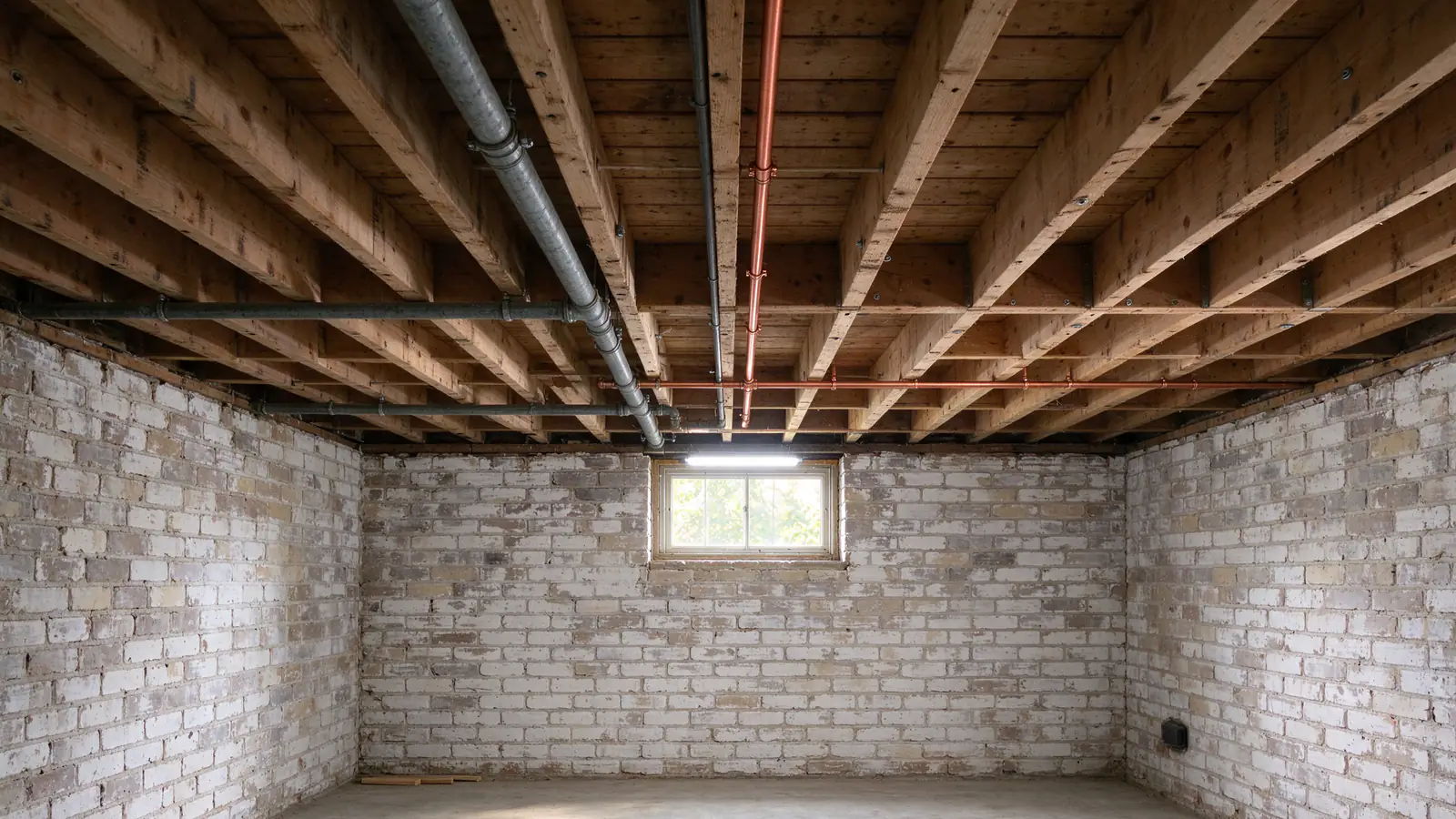
- The rim joist, the band of framing at the top of a basement wall, where outside air leaks in through gaps around the sill.
- Unheated porches, rear stairwells and garages where a line passes through on its way to a fixture or a hose bibb.
- Crawlspaces under an addition or a rear room.
- Hose bibbs with the hose still connected, which keeps water in the faucet body.
The causes are the same in each case: the pipe’s route runs through an unconditioned space, insulation is thin or missing, air leaks bring outside air to the pipe, and the weather is severe enough. Fixing any one of those lowers the risk.
Why freezing splits a pipe
Water expands as it turns to ice. When ice forms in one spot, it can block the pipe, and the water trapped between the ice and a closed faucet has nowhere to go as more of it freezes. Pressure builds in that trapped section until something gives. That is why a burst can appear some distance from the coldest spot, and why the leak can show up only when the ice thaws and water flows again.
Old pipe is less forgiving of that stress. Galvanized steel corrodes from the inside and is thinnest at its threaded joints, so the joint is where a freeze is likely to finish what corrosion started. Temperature changes put repeated stress on the system too, as pipe and fittings expand and contract with each warm and cold swing; a joint that is already weak is where that stress shows. The galvanized pipes guide explains how that corrosion works.
What Chicago’s code says
The Chicago Plumbing Code, section 18-29-605.22, says that all new concealed water pipes, and all pipes or tanks exposed to low temperatures, shall be protected from freezing. Water service pipe in the ground must be buried at least 5 feet deep under section 18-29-605.24, which is why the service line comes through the basement wall well below the frost.
For a homeowner, that means the code’s expectation is protection, not luck. A new line that has to pass a cold space is insulated or rerouted, and an old line in an exposed spot is a candidate for the same treatment.
Before the first hard freeze
- Find the main shutoff and test it. It sits near the meter where the service line enters. Turn it to make sure it closes. An old valve that is seized or will not shut off fully is worth replacing before winter, not during a burst; see main shutoff replacement.
- Disconnect hoses from outdoor faucets. If a hose bibb has a separate shutoff inside, close it and open the outside faucet to drain it.
- Seal air leaks at the rim joist and around any pipe where it passes through an outside wall.
- Insulate exposed pipe in unheated spaces, porches and crawlspaces with pipe insulation sized to the line.
- Keep the heat on, including in a vacant unit of a two-flat or a house you are away from.
- In a cold snap, open the cabinet doors under sinks on exterior walls so room heat reaches the pipes.
If a pipe freezes or bursts
If a faucet gives a trickle or nothing in cold weather, a line may be frozen. Open that faucet so water can flow as it thaws, and warm the suspected section gently with a hair dryer or warm air. Never use an open flame on a pipe inside a wall or near wood framing. If the pipe has split, or you cannot find the frozen section, close the main shutoff and call a plumber. After any burst, open the walls around it far enough to dry them out.
What a repipe can change, and what it can’t
A repipe replaces the pipe, but a new copper line in a cold wall can freeze just like the old one. New material alone does not remove freeze exposure. What a repipe does give is a chance to choose the route: to bring a branch in from an interior wall instead of an outside one, to keep risers inside the heated part of the house, and to insulate the new pipe wherever it passes near a cold surface. The plaster walls guide explains how routes are chosen, and living through a repipe covers the water-off windows if the work happens in winter.
If a past freeze showed you where the weak points are, write them down: which fixture, which wall, which day. That list is useful at the first visit, which starts at the meter and the main shutoff. Call the number on this page or use the estimate form to set one up.