Chicago’s plumbing code now requires a pressure-reducing valve wherever static water pressure at any fixture or outlet exceeds 80 psi. The valve has to bring the pressure down to 80 psi or less. The rule came in with the City’s Phase 3 construction codes ordinance, and the Department of Buildings made it mandatory for permit applications started on or after December 1, 2026. Before that, the threshold was 100 psi.
Chicago Lake Repiping offers and manages main water line and shutoff replacement and whole-house repiping across Chicago and nearby Cook County suburbs, with the work done by licensed and insured plumbing contractors. This guide explains what the new threshold means, what a pressure-reducing valve does, and why pressure belongs in every repipe assessment.
What changed in the code
The City Council passed the Phase 3 Construction Codes Modernization ordinance on June 17, 2026. Among its plumbing changes, section 18-29-604.8 now calls for a pressure-reducing valve where static pressure exceeds 80 psi at any fixture or outlet, with the valve reducing the pressure to 80 psi or less. The earlier version of the section set the line at 100 psi.
The Department of Buildings announced that the new provisions could be used from October 1, 2026 and are mandatory for permit applications started on or after December 1, 2026. A permit follows the code edition in effect when its application was submitted, so a repipe permitted under the new rules is checked against the 80 psi threshold. The same ordinance also requires check valves or other provisions at points where hot and cold water systems interconnect, and it kept the rule that no water service may be smaller than 1 inch nominal pipe size. The post on the code modernization covers the rest of what changed for repipes.
What a pressure-reducing valve does
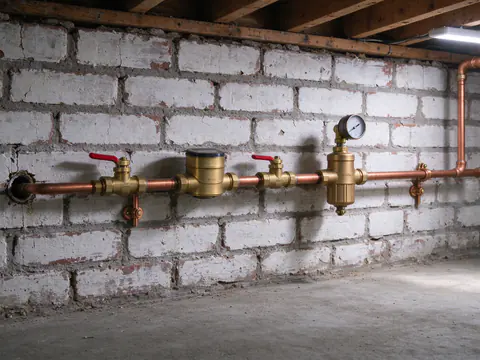
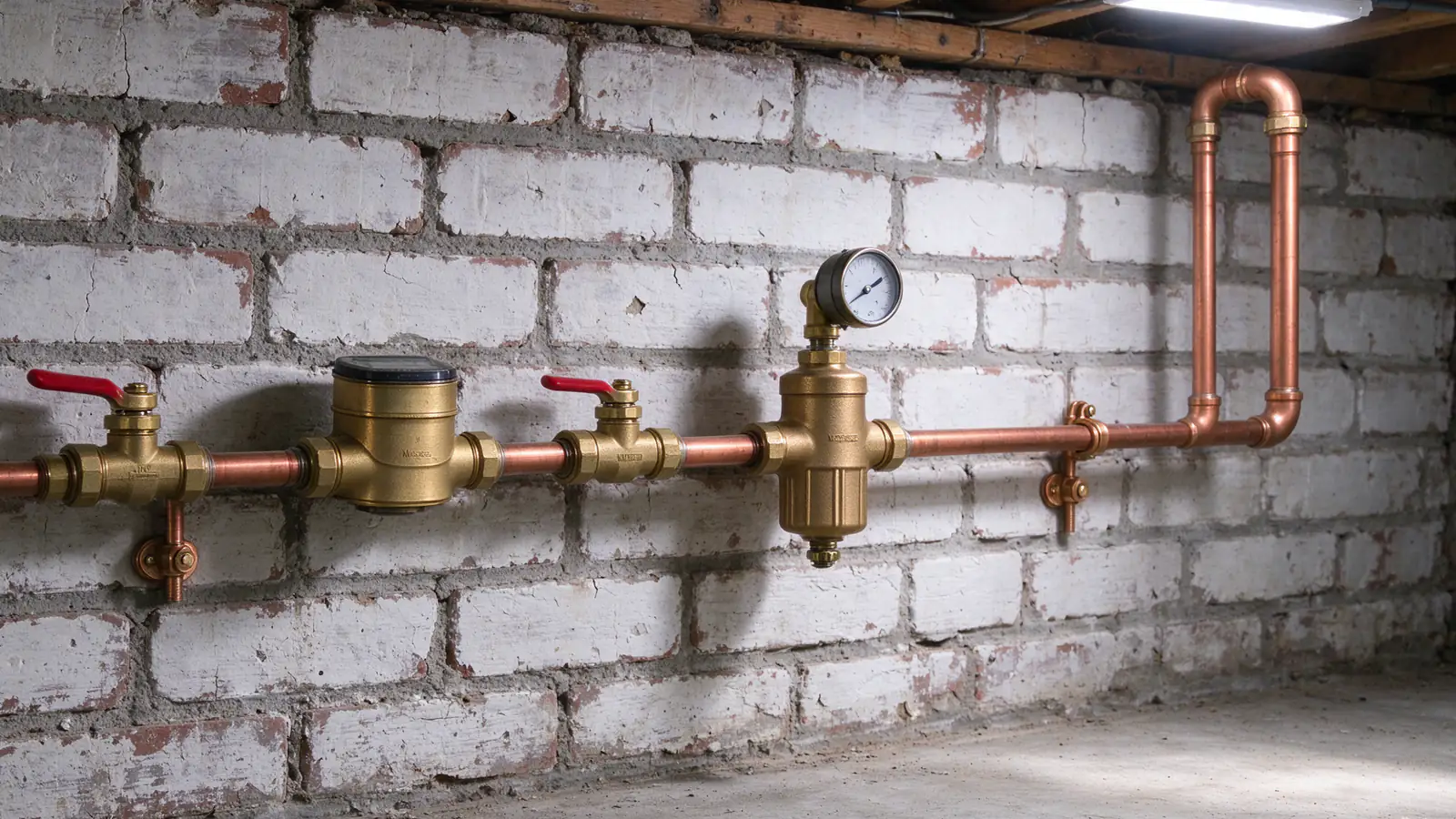
A pressure-reducing valve sits on the incoming water line after the main shutoff. Inside it, a spring presses against a diaphragm connected to the valve seat. When downstream pressure falls below the setting, as it does when a tap opens, the spring opens the seat and lets more water through. When pressure downstream rises to the setting, the diaphragm pushes back and the seat closes down. The house sees a steady pressure set by the spring, whatever the street is doing, as long as the street pressure is higher than the setting.
That last condition matters. A pressure-reducing valve only lowers pressure. If the street supplies less than the setting, the valve does nothing useful, and if the valve itself is clogged, set too low or failing partly closed, it becomes a restriction for the whole building. A failing valve can also let pressure creep up, or swing, as demand changes.
Why high pressure stresses a plumbing system
Pressure pushes outward on every part of the system at once, all the time, whether or not water is moving. Every joint, every valve seat, every flexible connector under a sink and the water heater’s connections carry that load. Excessive water pressure is plumbing stress: it does not corrode metal on its own, but it works on the weakest points. A threaded galvanized joint thinned by rust, a copper wall thinned by pitting or a worn fixture cartridge gives way sooner under higher static pressure.
Pressure also feeds water hammer, the bang when a valve closes quickly and the moving water stops against it. Higher pressure means more energy in that surge. New pipe does not end that on its own; the surge has to be addressed where it starts, with the pressure, the valves and the way the pipe is supported. The copper pinhole leak guide covers how pressure fits among the causes of leaks in copper.
Height changes pressure too. Water loses about 0.43 psi for every foot it rises, so the top floor of a three-story building sees noticeably less static pressure than the basement. In taller buildings, the code’s threshold applies at any fixture or outlet, which is why pressure is evaluated through the building rather than only at the meter. Commercial repiping and riser replacement cover larger buildings.
Measuring pressure the right way
The first visit for a repipe starts at the meter and the main shutoff. Static pressure is read at a hose bibb or test point with nothing in the house running, and flow is compared at the lowest and highest fixtures with two taps open. Those readings answer different questions:
- High static pressure points to a pressure-reducing valve under the new threshold, whatever the piping looks like.
- Good static pressure and poor flow upstairs point at the interior piping, which is the case for a repipe.
- Low static pressure points upstream: the street, the service line, the valve at the meter or a pressure-reducing valve that has failed partly closed.
Static pressure on the street can vary with demand and the time of day, so a single reading is a snapshot. A reading near the threshold is worth repeating. The low water pressure guide for older Chicago houses walks through the full sequence.
Want your pressure read before you plan a repipe?
The first visit starts at the meter with a static reading and a flow comparison top to bottom.
How the valve fits into a repipe
A repipe starts at the main shutoff, so the pressure-reducing valve, if one is needed, sits at the beginning of the new system. Planning it in the repipe means the new copper is protected from the first day, and the valve, the shutoff and the first lengths of new pipe are installed and tested together. The quote should say whether a valve is included, where it goes and whether the main shutoff is being replaced at the same time.
The Express permit for a repipe does not cover work on the water meter or the connection to it, which needs a separate water permit; the Chicago repiping permit guide explains that boundary. A valve installed downstream of the main shutoff is part of the interior piping.
None of this promises better pressure. A repipe removes restriction inside the walls; a pressure-reducing valve caps pressure that is too high. Neither one raises the pressure the street delivers, and homeowners report repiping and finding pressure unchanged because the old service line was the restriction.
The suburbs
The 80 psi rule is the City of Chicago’s. Each suburb enforces its own adopted plumbing code; Oak Park and Skokie follow the Illinois Plumbing Code, and Evanston and Park Ridge have their own amendments. Whether a pressure-reducing valve is required, and at what pressure, is confirmed per address before work starts. See Oak Park and Evanston.
Where to start
Borrow or buy a gauge that threads onto a hose bibb and take a static reading with nothing running. If it reads above 80 psi, the valve belongs in the plan; if it is low, look upstream before looking at the walls. Call the number on this page or use the estimate form to set up a walk-through that starts at the meter.