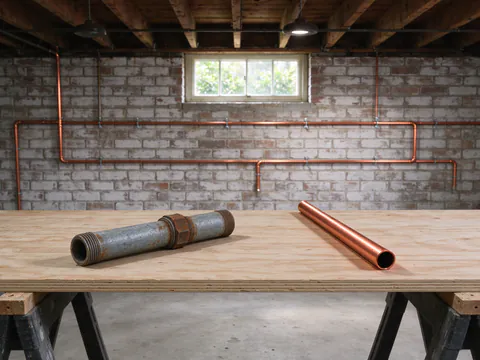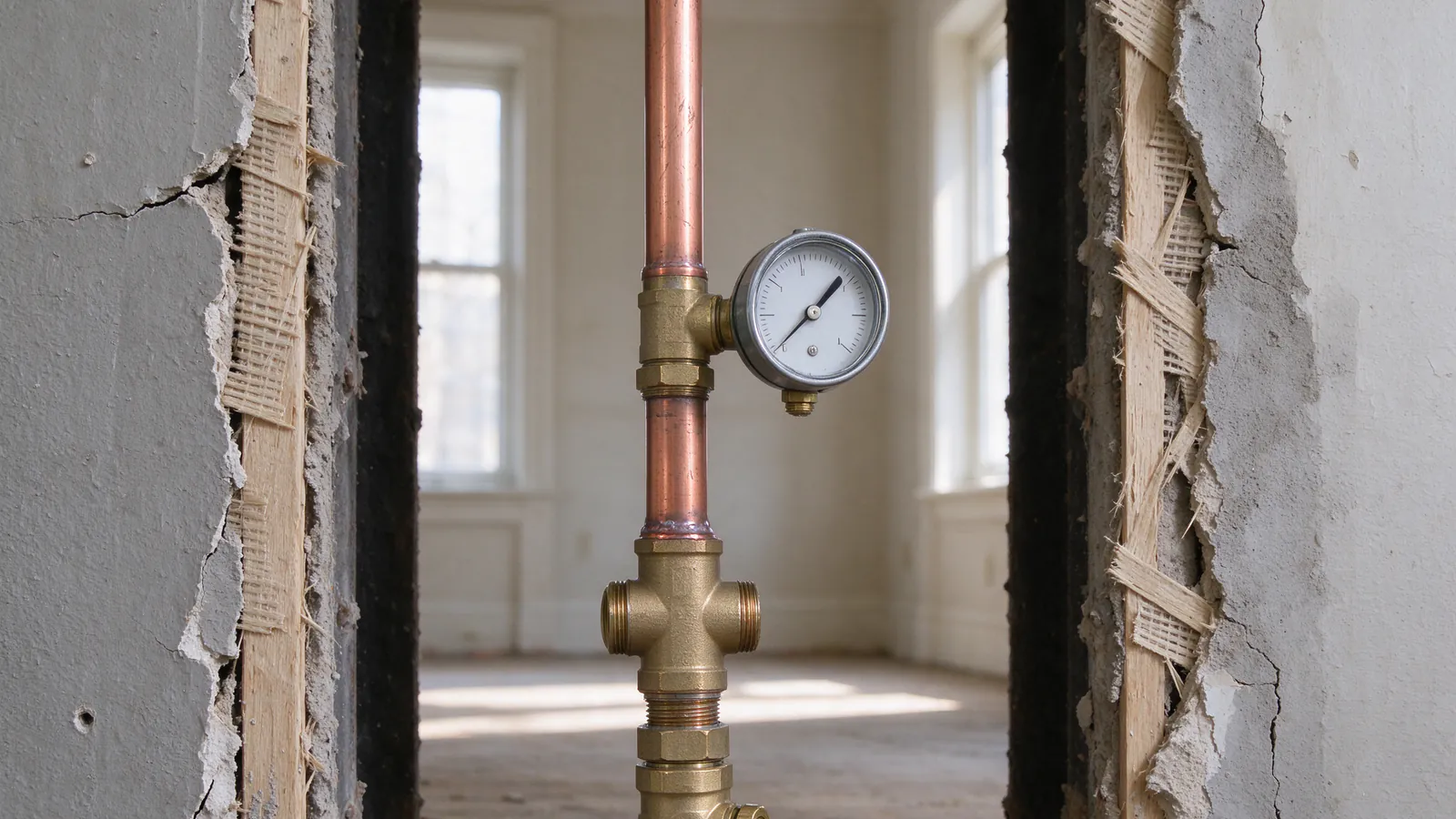
Low pressure in an old Chicago house can come from the street, the buried service line, a valve at the meter, a pressure-reducing valve that has failed partly closed, narrowed galvanized pipe inside, or the fixtures themselves. A repipe fixes only the interior pipe. Static pressure at a hose bibb and flow at the lowest and highest fixtures tell you which one it is before you pay for anything.
Homeowners report repiping an old house, sometimes at real expense, and finding the shower upstairs no better, because the buried line out front was the bottleneck all along. Chicago Lake Repiping offers and manages galvanized pipe replacement and the related service line work across Chicago and nearby Cook County suburbs, with licensed and insured plumbing contractors doing the work, and the order of testing below is how a walk-through avoids that outcome.
Two numbers that sort it out
Pressure and flow are not the same thing, and confusing them is how owners end up paying for the wrong fix.
Static pressure is the force in the system with no water moving. It is read with a gauge threaded onto a hose bibb or a test point, with every fixture off. It reflects the pressure arriving from the City’s main, less whatever the service line and the valves at the meter take away when nothing flows.
Flow is what you notice at the shower. It is checked by opening the lowest fixture and the highest fixture, then running a second fixture while watching the top one. Narrowed pipe can show a perfectly good static reading and still collapse when two taps open, because rust and scale have taken the space water needs to move.
A walk-through starts here: at the meter and main shutoff, a static reading at a hose bibb, then a flow comparison between the lowest and highest fixtures. No published figure gives a normal pressure for a given Chicago street, so the reading at your hose bibb is the number that counts.
Rule out the causes in order
| Where | What goes wrong | What the tests show | Fix |
|---|---|---|---|
| The street | Pressure in the main is low at that location or time | Low static pressure; neighbors notice it too | A question for the water utility, not a plumber |
| Service line | Old lead or galvanized line, small or narrowed inside | Low static pressure, or a static reading that drops hard as soon as water runs | Service line replacement, a separate project and permit |
| Valves at the meter | A meter valve or main shutoff partly closed or failing inside | Low pressure or flow from the meter onward, both hot and cold | Open or replace the valve; meter work needs a City water permit |
| Pressure-reducing valve | A valve that has failed partly closed, or is set too low | Pressure below the street’s after the valve | Adjust or replace the valve |
| Interior galvanized pipe | Scale and rust narrow the bore | Good static, poor flow upstairs, worse with two fixtures running | Partial or whole-house repipe |
| Water heater | Valve, connections or hot lines restricted | Hot side weak, cold side fine | Heater connections or hot-side piping |
| Fixtures | Clogged aerator, worn cartridge, corroded stop | One fixture weak, the rest normal | Clean or replace the fixture parts |
The street comes first because nothing inside the house can add pressure that never arrives. The service line comes next because it sets a ceiling for everything after it. Chicago’s plumbing code requires a minimum water service of 1 inch for new work, and a lead or galvanized line from decades ago can be smaller and narrowed inside. One homeowner describes pressure under 40 psi in a 1930 house with its original water main, barely enough to run two fixtures at once. Where the old service line is that restriction, repiping the inside alone will not change the reading.
The valves at the meter come next. A main shutoff that has not been turned in decades can fail partly closed inside, and the meter itself sits in the path. Any work on the meter or its connection needs a City water permit, separate from a plumbing permit.
Pressure-reducing valves matter more now that Chicago’s code requires one where static pressure exceeds 80 psi, for permit applications from December 1, 2026. A valve that has failed or is set too low cuts pressure to the whole building. The Chicago pressure-reducing valve guide covers the rule.
Only after those does the interior pipe take the blame. The cornerstone guide to galvanized pipes explains why galvanized narrows from the inside while the outside looks fine.
Upper floors in two-flats and multi-flats
Two-flat and three-flat owners describe the same pattern: the upper unit’s shower dies when someone downstairs runs the kitchen tap, and they ask whether the supply was sized for a single-family house. Several things stack up against the top floor. It is the highest point, so it gets the least pressure; it is the end of the longest run; and in an old building its supply comes through a shared basement main and risers that may be narrowed galvanized.
One Chicago triplex owner described pipes inside the walls that were steel, with their inner diameter narrowed by rust, and upper units that lost water after a new line was connected. The fix there was replumbing in 3/4 inch Type L copper. Upsizing the main and risers during a two-flat repipe can restore flow to the upper unit where the interior pipe is the restriction, and the two-flat cost guide covers what that involves. Where the service line is the restriction, the service line has to change too.
Weak shower upstairs?
A walk-through reads static pressure at the meter and compares flow at the top and bottom of the house.
After a repipe or a new service line
Pressure problems can also show up after work, and the cause points back to the same list. After a service line replacement, loosened scale can lodge in aerators and valves; the City recommends flushing after any service line work. After a partial repipe, the remaining galvanized section can still restrict the fixtures it feeds. And a repipe that leaves an old, small service line in place inherits that line’s limit.
That last case is why the order of projects matters. If the service line is old and the interior is galvanized, plan both together; the guide to repiping after a lead service line replacement covers the sequence, and lead service line replacement covers the line itself.
What to do this week
Clean the aerators on the weak fixtures and see whether flow returns. Check that the main shutoff is fully open, without forcing an old valve. Ask a neighbor whether their pressure has changed. Then look at the pipe at the basement wall and the pipe leaving the meter; the guide to identifying your water pipes shows what each material looks like.
If the cause is still unclear, a walk-through that starts at the meter measures static pressure, compares flow at the lowest and highest fixtures, and tells you whether the answer is a partial repipe, a whole-house repipe, the service line, or something smaller. Call the number on this page or use the estimate form.