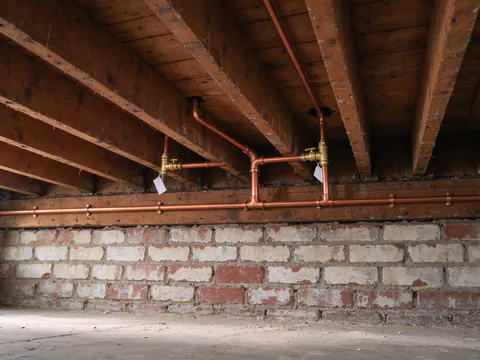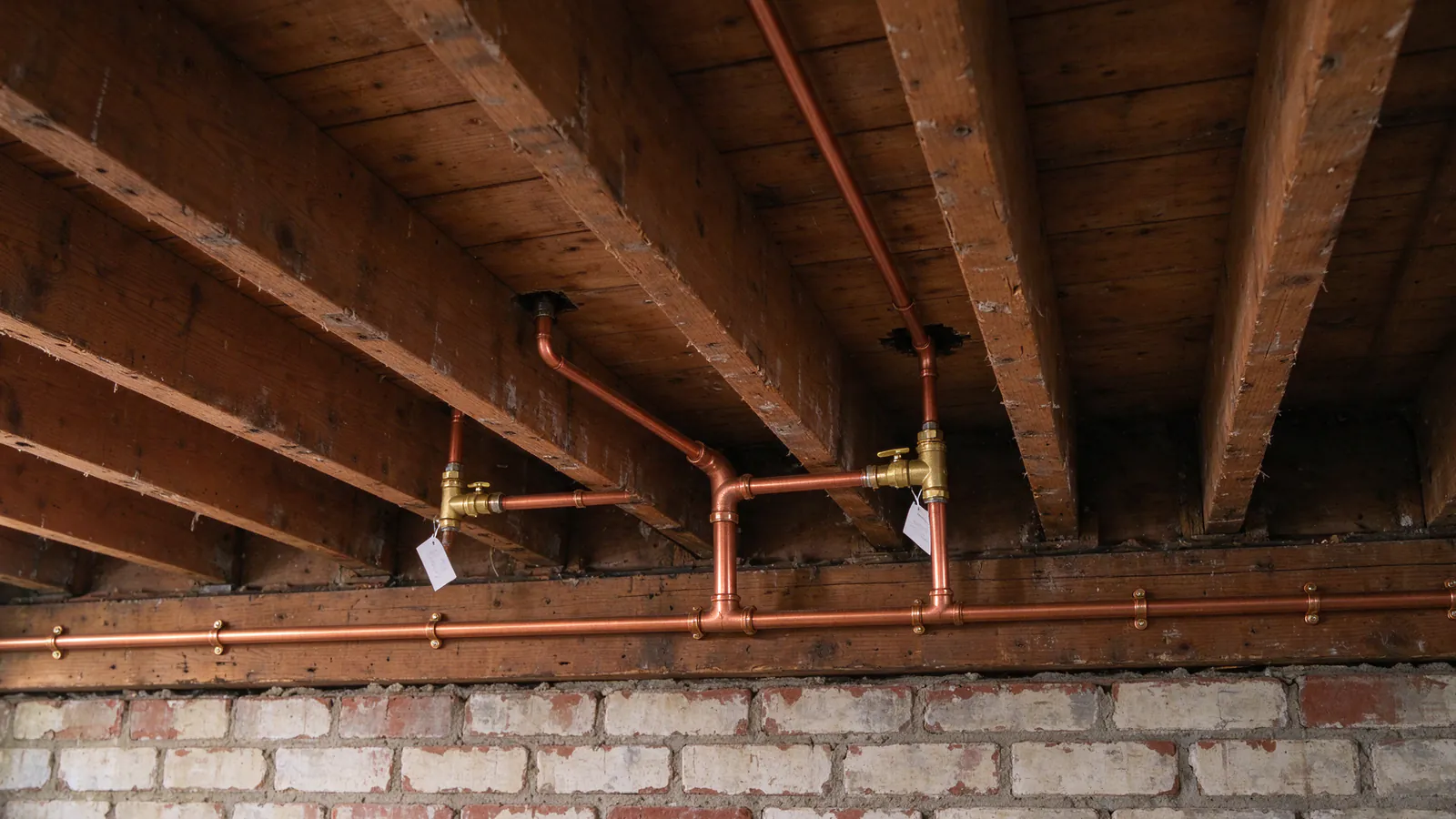
A whole-building repipe of a Chicago two-flat runs $8,000 to $18,000+, a typical Chicago-area range, with larger or fully finished buildings running higher. The City’s Express plumbing permit adds $150 per dwelling unit, so $300 for both, and another $150 per unit served when the risers are replaced. A price for a specific building comes after a walk-through from the meter to the top floor.
Two-unit buildings hold 13.1% of Chicago’s housing units, by U.S. Census Bureau figures compiled by the Chicago Metropolitan Agency for Planning, and 38.8% of the city’s housing units were built before 1940. Chicago Lake Repiping offers and manages two-flat repiping across Chicago and nearby Cook County suburbs, with the work done by licensed and insured plumbing contractors who hold a City of Chicago license for work inside the city. This guide breaks the two-flat price into its parts and shows which ones have a public figure.
The two-flat range and what it covers
| Work | Typical range | What the range covers |
|---|---|---|
| Two-flat, whole building | $8,000 to $18,000+ | Both units’ hot and cold supply piping, the shared basement main and the risers. Larger or fully finished buildings run higher. |
| Single-family whole-house repipe, for comparison | $5,000 to $15,000+ | Supply piping from the main shutoff to every fixture in one dwelling |
| City of Chicago Express plumbing permit | $150 per dwelling unit | Repair or in-kind replacement of existing piping; $300 for a two-flat |
A two-flat is not two houses stacked up. The units share one water service, one meter, one main shutoff and one basement, so the basement work is done once. What doubles is everything above it: two kitchens, two bathrooms, two water heater connections and two sets of fixture branches. That is why a two-flat range sits above a single-family range without being twice it. The Chicago repipe cost guide covers the single-family side.
What moves a two-flat price
| Factor | Why it changes the price |
|---|---|
| Fixtures in each unit | Each sink, tub, toilet, laundry hookup and hose bibb is a branch and a connection. A second bathroom in either unit adds a group. |
| Riser route | Risers in an existing chase or stacked closets run with few openings. A new route through the floor between units is a different permit, covered below. |
| Basement condition | Open joists let the main and trunks run without opening anything. A finished basement unit or ceiling has to be opened and closed. |
| Plaster, tile and cabinets | Pre-war two-flats with plaster on lath on both floors take more careful openings and more restoration; see repiping plaster walls. |
| Water heaters | Each unit’s heater is reconnected. Replacing one adds equipment and a permit line. |
| Pipe size for the upper unit | Homeowners report upper units with poor pressure in buildings whose supply looks sized for one household; upsizing the main and risers adds material. |
| Both households in residence | Cutovers are planned around two kitchens and two bathrooms, which can add days. |
| Main shutoff and valves | A seized main shutoff, missing unit shutoffs or a needed pressure-reducing valve add parts and labor at the start of the system. |
| Old fixtures fused to galvanized | Homeowners report faucets and stops threaded to old pipe coming out with it, turning a pipe job into fixture work too. |
What’s inside a Chicago two-flat repipe price
| Part of the price | What sets it | Local figure |
|---|---|---|
| Labor | Hours on site, set by two units’ fixtures, the risers and access | Plumbers in the Chicago metro earn a mean $46.36 an hour against $34.70 nationally, about 34% higher; the medians are $49.70 and $30.67 (Bureau of Labor Statistics, Chicago metro; national) |
| Pipe and fittings | The material the code lists for the address | Inside Chicago, Table 18-29-605.5 lists copper and no PEX. Copper is the higher-cost material, and the federal producer price index for copper and brass mill shapes rose about 30% over one recent year |
| City permit, piping | Number of dwelling units | $150 per dwelling unit, so $300 for a two-flat (Department of Buildings) |
| City permit, risers | Risers replaced in an existing chase | $150 more per dwelling unit served, so another $300 when both units’ risers are replaced |
| City permit, water heater | Only when a heater is replaced | $75 per dwelling unit, or $150 for a single heater serving more than one unit |
| Plan review | Work that alters, reconfigures or extends the system, including new penetrations between units | $600 non-refundable initial deposit, with the total set by scope |
| Work without a permit | Starting before the permit is issued | A stop work order penalty of $1,000 or more; the permit fee after one is in most cases tripled (Department of Buildings) |
| License | Who may do the work | A City of Chicago plumbing contractor license is required (who can repipe in Chicago); a two-flat owner may not do the work under the single-family exemption |
| Riser drawing | Required with any riser work | A drawing of the entire riser showing size and material; no public figure for preparing it |
| Wall, ceiling and floor restoration | Openings in both units and the basement, plaster or drywall, paint | No public figure. Scope to check on the quote |
| Main shutoff, unit shutoffs, pressure-reducing valve | Condition found at the meter | No public figure. Scope to check on the quote |
| Service line | Material and size of the line from the street | A separate lead service line project with its own permit; covered in the lead service line cost guide |
A wage is not a billing rate. A contractor’s rate also carries insurance, licensing and bonding, vehicles, tools, permit time and overhead, so it cannot be compared with the wage figures above. The wage gap is still a plain public reason that Chicago work costs more than a national average suggests.
Permits for a two-flat, line by line
The Express Permit Program covers repairing or replacing existing supply piping, existing risers inside a building, fixtures and water heaters, with fees counted per dwelling unit:
| Permit line | Fee | When it applies |
|---|---|---|
| Piping repair or in-kind replacement | $150 per dwelling unit ($300 for a two-flat) | Every two-flat repipe |
| Risers in an existing chase | $150 more per dwelling unit served | When the vertical lines to the second floor are replaced in their existing path |
| Water heater | $75 per dwelling unit; $150 for one heater serving several units | Only when a heater is replaced |
| Standard plan review | $600 non-refundable initial deposit | Work that alters or extends the system |
| Water permit | Set by the Department of Water Management | Any work on the meter or the service line |
Riser work needs a drawing of the whole riser, showing size and material, uploaded with the application. Express plumbing work cannot create new or larger penetrations in the walls or floors that separate units, corridors or stairways, and firestopping is required where new pipe passes through existing openings. In a two-flat, the floor between the units is one of those separations. A riser that can follow the old pipe’s path stays in the Express program; a riser that needs a new hole through that floor pushes the job toward plan review, with its own deposit and timeline. The Chicago repiping permit guide covers the application.
Pricing a two-flat?
A walk-through from the shared meter maps both units, the risers and the openings before a number is written.
Pressure upstairs and pipe sizing
Homeowners in Chicago multi-flats report that the upper unit loses pressure whenever someone downstairs runs water, and ask whether the supply was sized for a single-family house. The cause can sit in several places. A narrowed galvanized main in the basement starves both units; galvanized risers narrow the upper unit’s supply on their own; and the service line from the street sets a ceiling on everything. Chicago’s code keeps a minimum water service of 1 inch for new work, and an old service can be smaller.
A repipe can upsize the basement main and the risers, which helps where the interior pipe is the restriction. It cannot fix a small or narrowed service line, which is a separate project. The low water pressure guide covers how static pressure and flow at the top floor are compared to tell the two apart.
Programs and what they pay for
| Program | What it pays | Covers a two-flat’s interior piping? |
|---|---|---|
| Interior repiping (City, state or federal) | No program found | No |
| Chicago Equity lead service line replacement | Free full replacement of the lead service line and a meter for income-qualified owner-occupants of a house or two-flat; the City values it at $16,000 to $30,000 (Lead-Safe Chicago) | No |
| Chicago Homeowner-Initiated lead service line replacement | Permit fees waived for a standalone full lead line replacement; the City connects the new line to the main | No |
The service line programs stop at the building. A two-flat that gets a new copper service still has its old piping inside, and the two projects run on separate permits; the guide to repiping after a lead service line replacement covers how to sequence them.
Illustrative budgets
These examples are illustrative only. They show how the published range and the City’s fees combine. They are not quotes and do not describe real jobs.
Illustrative: a brick two-flat with an unfinished basement and one bathroom per unit, risers in a stacked chase. The repipe would fall within the $8,000 to $18,000+ two-flat range, toward the lower part if the chase opens from a closet on each floor. Permit: $150 per unit for the piping, $300 for both, plus $150 per unit served for the risers, another $300. Restoration: priced on the quote.
Illustrative: a greystone two-flat with plaster throughout, a finished garden-level space and a second bathroom upstairs. The finished ceilings, the extra bathroom and plaster on every wall push toward the top of the range or past it. Permit lines as above, plus $75 per unit for any water heater replaced at the same time. If the old risers cannot be followed and a new path through the floor between units is needed, the job moves toward plan review, which starts with a $600 deposit.
Illustrative: a two-flat in Austin where both households stay in residence. The same range applies; scheduling the cutovers around two kitchens and two bathrooms adds days rather than a separate fee. The guide to living through a repipe covers water-off windows.
Reading a two-flat quote
Put any two quotes side by side and check that each one names the copper type and joint method; covers both units, the shared main and the risers; lists each unit’s water heater connection and shutoffs; includes the permit lines for piping and risers; lists the openings in each unit and the basement and says who closes them and to what finish; says where any old pipe stays in the walls; and gives the water-off windows for each household. Homeowners report quotes that leave wall cutting and patching out entirely, which makes them look cheaper than they are.
The galvanized pipe cornerstone guide covers how to tell whether the building needs a repipe at all, and the repipe cost estimator works from the same published ranges. Call the number on this page or use the estimate form to set up a walk-through of both units.