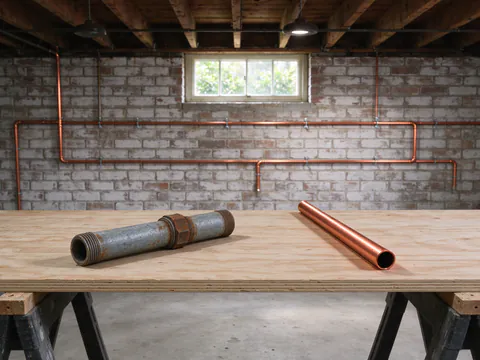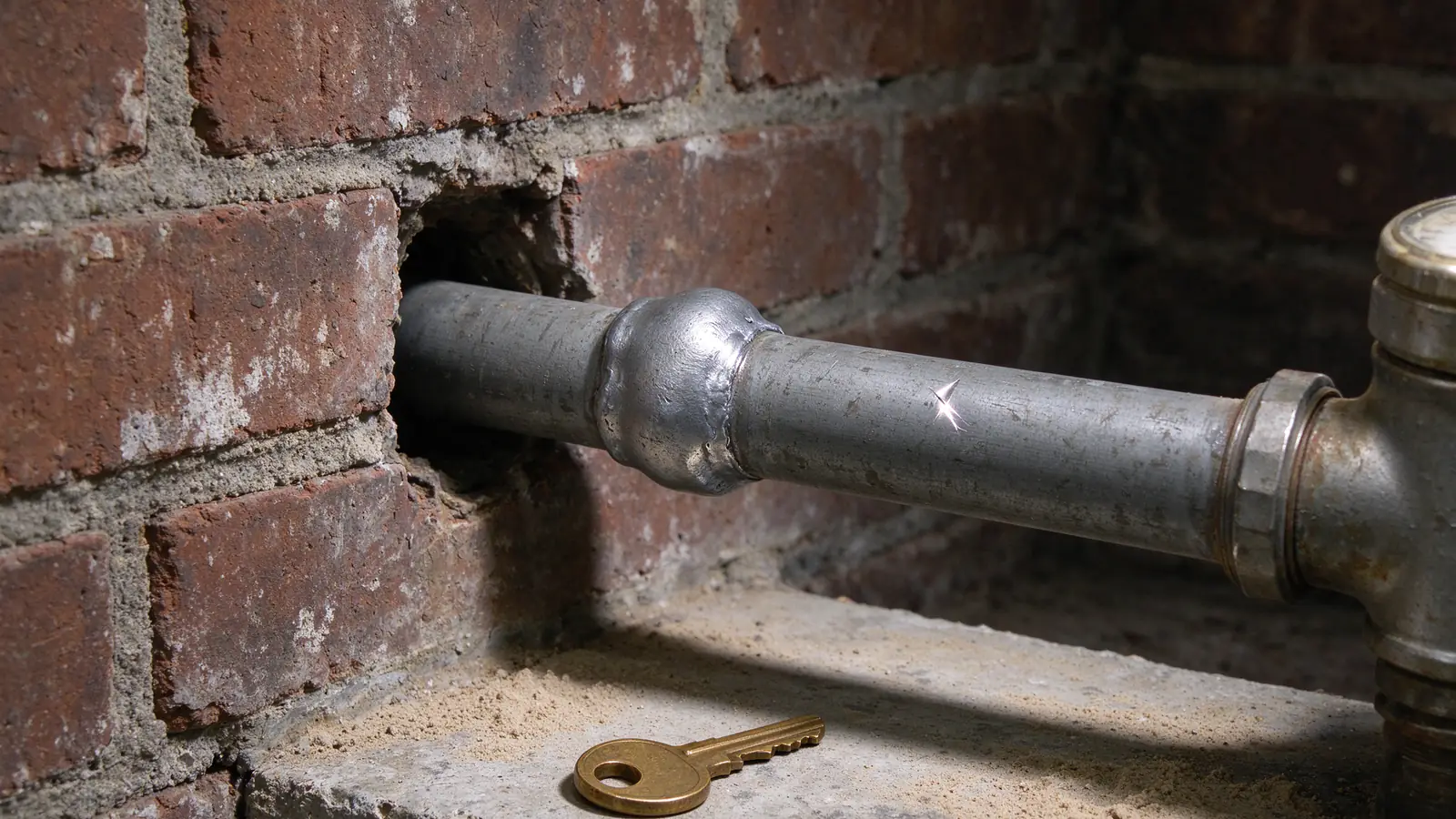
Much of the answer is at the basement wall, where the water line comes in from the street to the meter. Galvanized steel is gray, threaded and holds a magnet. Lead is gray, soft and not magnetic, and a light scratch shows bright silver. Copper is reddish brown, not magnetic, and scratches pink. Brass is yellowish, threaded and not magnetic. What runs inside the walls takes more work to see.
The test needs only a fridge magnet and a coin or key. Chicago Lake Repiping, which offers and manages galvanized pipe replacement, whole-house repiping and lead service line replacement across Chicago and nearby Cook County suburbs through licensed and insured plumbing contractors, put this guide together so that a homeowner can sort out the basics before anyone opens a wall.
Where to look
The service line. In the basement, find where the water pipe comes through the foundation wall or up through the floor from the street. That short exposed length, before the meter or main shutoff, is the end of your service line. It is the pipe Chicago’s lead inventory rates.
The meter and main shutoff. The water meter, if the building has one, sits on that line near the wall, with the main shutoff valve on one side or both. Do not confuse it with the gas line: gas pipe is also threaded steel, but it runs to the gas meter and to the furnace, water heater burner and stove, not from the foundation to the water meter. Homeowners report mistaking the gas shutoff for the water main, so follow the pipe.
The interior piping. The pipe that leaves the meter and main shutoff is the house’s own supply system. Follow it to the water heater, along the basement joists, and to wherever it rises into the floors above. Check again at the water heater connections, under the kitchen sink and at the laundry, because old houses mix materials.
What each material looks like
| Material | Color | Joints | Magnet | Light scratch |
|---|---|---|---|---|
| Galvanized steel | Dull silver-gray; may show rust at joints | Threaded fittings screwed onto the pipe | Sticks firmly | Gray steel |
| Lead | Dull gray, soft | Smooth bends, rounded bulge where joined | Does not stick | Bright, shiny silver |
| Copper | Reddish brown, dark brown or green with age | Soldered or pressed fittings, smooth | Does not stick | Pink, penny color |
| Brass | Yellowish to dull brown | Threaded, like galvanized | Does not stick | Yellow, gold-toned |
| Plastic (PEX, CPVC, PVC) | Red, blue, white or cream | Crimp rings, clamps or glued fittings | Does not stick | Not needed |
Galvanized steel is the threaded gray supply pipe that turns up in older Chicago houses. Lead turns up on service lines and sometimes inside older homes; Lead-Safe Chicago says the city’s service lines were primarily lead until the federal ban in 1986. Brass is still listed in Chicago’s plumbing code and appears in older buildings and in valves and fittings. Plastic water pipe is not listed for water distribution inside Chicago, so plastic in a city house is either a past repair or something a previous owner added (the guide to whether PEX is allowed in Chicago covers what to do about it); in suburbs that follow the Illinois code, PEX can be the original pipe of a newer system.
How to test safely
Lead-Safe Chicago gives the same two tests for a service line: hold a magnet to the pipe, and if it does not stick, scratch it lightly with a key. Lead is soft enough that the scratch shows silver.
Keep it gentle and keep it to the right spot:
- Scratch lightly, on a straight run of pipe. A coin edge or key is enough. Do not file, cut, saw or drill into any pipe.
- Stay away from joints and anything under strain. Old threaded joints and lead pipe can be weak, and a pipe that moves when touched should be left alone.
- Leave the grounding wire alone. A clamp with a heavy wire attached to the water pipe near the meter is part of the electrical system’s grounding or bonding. Do not touch, loosen or scratch near it, and do not remove a pipe it is attached to.
- Do not force the main shutoff. An old valve that has not been turned in years can break when forced. Testing the pipe does not require turning anything.
- Wash your hands after touching a pipe you suspect is lead, and do not sand or scrape it.
Lead-Safe Chicago asks residents to report what they find, which helps correct the City’s inventory. The guide to the galvanized requiring replacement label explains how that inventory sorts lines.
Reading what you find
Galvanized from the wall to the fixtures. The house may still have its original steel supply piping. That is the system that narrows from the inside, and the cornerstone guide to galvanized pipes covers what it means and what to do about it.
Lead at the wall, galvanized or copper after the meter. The service line is lead and is a separate project with its own rules and programs; see lead service line replacement and the lead line cost guide.
Copper at the wall, galvanized inside. The service has been replaced at some point, but the interior has not. A new service feeding old galvanized is the situation the repipe after lead service line replacement guide addresses.
Copper everywhere you can see. The visible pipe has been replaced. Check whether the copper rises into the walls or whether it changes to steel at the ceiling, and look for brass or dielectric fittings where copper meets steel.
A mix. Old houses carry their repair history in the basement: a copper section where a leak was fixed, a brass union, a short run of plastic. Each transition is a place to look closely, and the copper repiping page explains why copper and galvanized need a proper fitting between them.
Not sure what you're looking at?
A walk-through starts at the meter and names every pipe material from the wall to the top floor.
What you cannot tell without opening walls
The basement shows the ends of the system. Several things stay hidden:
- The inside of the pipe. Galvanized narrows from the inside while the outside looks fine. Only flow and pressure tests, or a cut section, show how much bore is left. The low water pressure guide covers the tests.
- The pipe in the walls. Copper in the basement can turn into galvanized risers above the ceiling, and pipe in the walls can include abandoned lines left from an earlier repair. Homeowners report finding disconnected old pipe behind a wall during a bathroom remodel.
- The buried line outside. The few inches of service line you can see may not match the rest. Homeowners report finding a newer copper intake beside an old, cut-off lead one, and service lines can be joined or branched underground. Confirming what is buried takes the City’s records or digging.
- Solder and fittings. Lead-Safe Chicago notes that lead can be present inside a home in old faucets, in the solder used to connect plumbing, and sometimes in interior lead pipe, and that faucets made before January 1, 2014 were allowed to contain more lead.
The City lookup and a water test
Two checks fill the gaps. The City’s service line inventory lookup, linked from the Lead-Safe Chicago water page, shows what the City’s records say about your service line. A free lead test kit, requested through 311 or the City’s water quality site, shows what actually reaches your tap. A test tells you about the water, not which pipe a result comes from, so it works best alongside what you found at the wall.
If what you found points to galvanized inside or lead outside, the next step is a walk-through that starts at the meter. Call the number on this page or use the estimate form, or try the do I need a repipe tool first.