Rusty or brown water from a faucet comes from one of four places: corroding galvanized pipe inside the house, the water heater, work on the City’s water mains, or sediment stirred loose in the lines. If only the hot side is brown, suspect the heater. If every tap runs brown and then clears, suspect the street. If certain fixtures run brown at the first draw, suspect the pipe feeding them.
The color tells you iron is in the water. It does not tell you where it came from, and the fix for each source is different. Chicago Lake Repiping offers and manages galvanized pipe replacement and whole-house repiping across Chicago and nearby Cook County suburbs, with licensed and insured plumbing contractors doing the work, and the pattern-matching below is how a walk-through decides whether the pipes are the problem at all.
Read the pattern
| What you see | Likely source | Next step |
|---|---|---|
| Brown water from hot taps only | Water heater sediment or rust; hot-side galvanized | Have the heater checked and drained; compare with the cold side |
| Every tap, hot and cold, at the same time | City main work, hydrant flushing, a disturbance upstream | Flush per the City’s instructions; report through 311 if it does not clear |
| Some fixtures, at the first draw, clearing after a minute | Galvanized branches to those fixtures | A plumber’s look at the pipe feeding them |
| Constant tint at every fixture in a house with old steel pipe | Galvanized throughout, possibly the service line too | Check the pipe at the meter and the pipe leaving it |
| A burst of brown after plumbing work or a shutoff | Scale loosened inside old pipe | Clean aerators and screens; flush |
| One faucet only | That faucet’s supply, valve or aerator | Clean the aerator; check the stop valve |
The table’s “likely source” is a starting point, not a diagnosis. Two sources can run at once: an old heater in a house with galvanized hot lines can produce the same hot-side color from both.
Galvanized pipe corroding inside
Galvanized steel is pipe coated with zinc. The zinc wears through from the inside over decades, and the bare steel rusts. Rust and scale build up on the inner wall and break loose in flakes, especially when water that has sat still starts moving again. That is why galvanized gives itself away at the first draw: the water that sat overnight in a rusty branch comes out tinted, then clears as fresher water arrives from the main.
Hot lines can corrode faster than cold, because warm water speeds the reaction. The same pipe that tints the water also narrows, so rusty water at certain fixtures and weak flow at the same fixtures point the same way. The low water pressure guide covers that side of it, and the cornerstone guide to galvanized pipes in Chicago homes explains the whole failure.
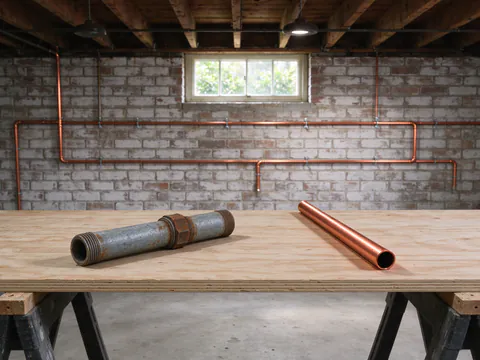
You can check what the pipe is in the basement: galvanized is gray, threaded and holds a magnet. The guide to identifying your water pipes shows how.
The water heater
A tank water heater collects sediment at the bottom and can rust inside as it ages. When that is the source, the color shows up on the hot side and the cold side runs clear. A plumber can drain the tank and look at what comes out, and check the connections and the pipe leaving the heater. If the hot lines are galvanized, they can be part of the problem too, which is why comparing a hot tap and a cold tap at the same fixture is the first test.
Replacing a heater does not fix galvanized hot lines, and repiping does not fix a rusting tank. Knowing which one it is avoids paying for the wrong job.
City main work and sediment
When every tap in the house runs brown at once, hot and cold, the cause sits upstream of the meter: work on a water main, hydrant flushing, or a change in flow on the block that stirs up sediment in the lines. That water reaches every fixture equally and tends to clear as the lines settle.
Lead-Safe Chicago, the City’s lead program, says that after work on the water mains outside your home, or after a house has sat vacant, you may need to flush more extensively than the everyday routine, and it publishes flushing instructions. When main work is scheduled on a block, the City offers eligible homes a free water filter set certified to remove lead. If brown water at every tap does not clear after flushing, report it through 311, the City’s line for water service problems.
After plumbing work or a shutoff
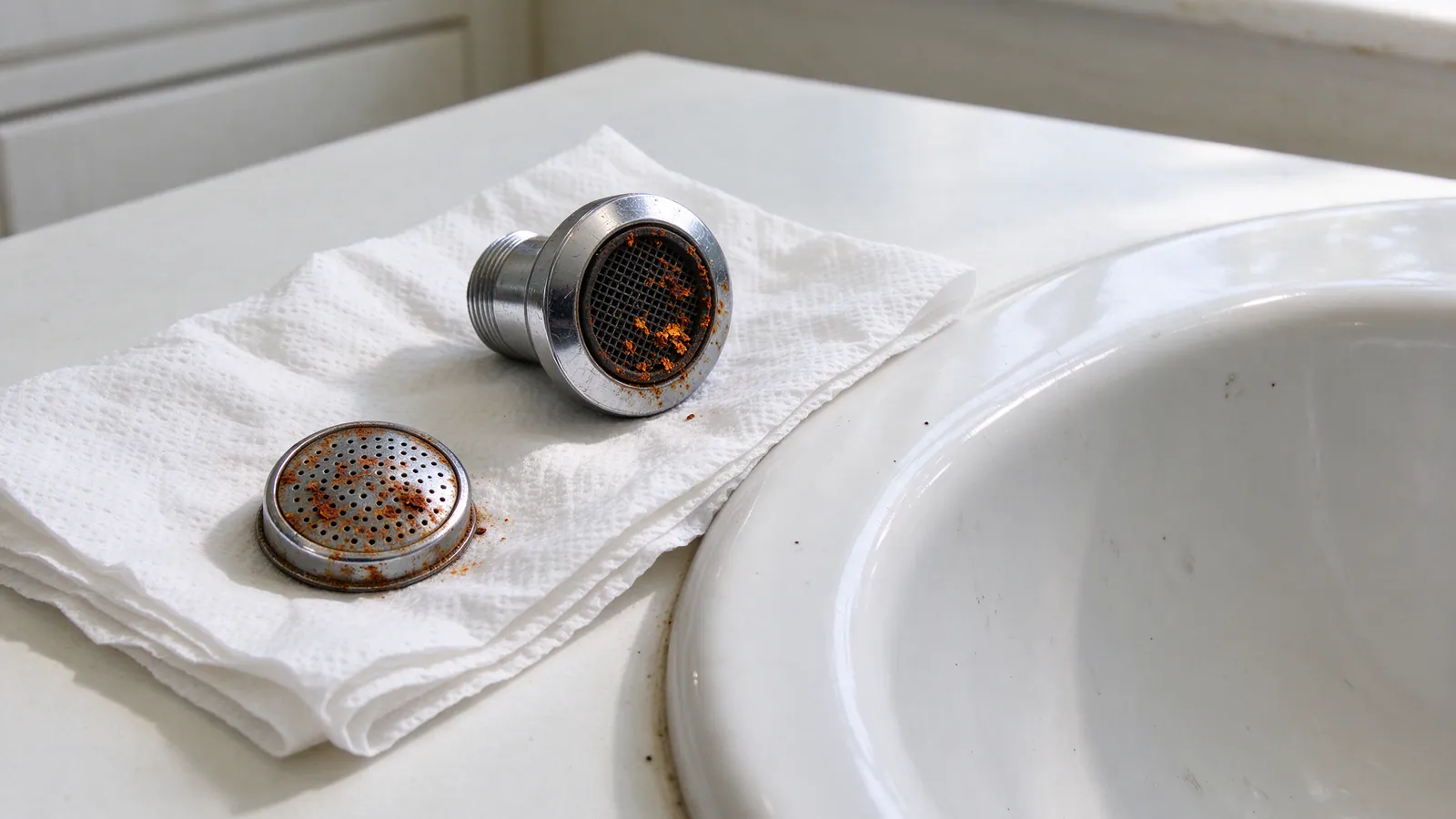
Cutting into old galvanized, or shutting the water off and turning it back on, shakes loose rust and scale that were stuck to the inside wall. The result can be a burst of brown water and clogged aerators, a toilet fill valve that sticks, or a faucet that suddenly runs weak. On a repipe, that is why the system is flushed after each cutover and the aerators and screens are cleaned before the job is done.
The City recommends cleaning faucet aerators at least once a month in any case, because sediment, rust and metals collect in them.
Rust color and lead are different questions
Rust is iron. A brown glass of water says nothing about whether lead is present, and clear water does not prove it is absent. In Chicago the first lead concern is the service line: Lead-Safe Chicago says service lines were primarily made of lead until the federal ban in 1986, and lead can also come from old faucets, solder and interior lead pipe. Galvanized pipe downstream of a lead line can hold lead particles in its rust, which is why the City’s inventory has a galvanized requiring replacement category.
The City’s guidance is to run the water for at least five minutes after it has sat six hours or more, and to drink and cook only with cold water, since hot water can dissolve lead more quickly. Any Chicago resident can request a free lead test kit through 311 or the City’s water quality site. That test, not the color, tells you what reaches the tap.
Brown water at some taps?
A walk-through starts at the meter and traces the color to the pipe, the heater or the street.
When to call the City and when to call a plumber
Call 311 when every tap runs brown at once, when the color follows work on the street, when you suspect a leak on the service line, or to request a free lead test.
Call a plumber when the color shows up only on the hot side, only at certain fixtures, only at the first draw, or after plumbing work inside the house. Those patterns point at the heater or the interior pipe, which are the owner’s to fix.
If the source is galvanized pipe inside, the choice is between a partial repipe of the branches that tint the water and a whole-house repipe that leaves no old supply pipe in service; the two-flat repiping page covers buildings with two units, and lead service line replacement covers the line from the street. Call the number on this page or use the estimate form to set up a walk-through that starts at the meter.