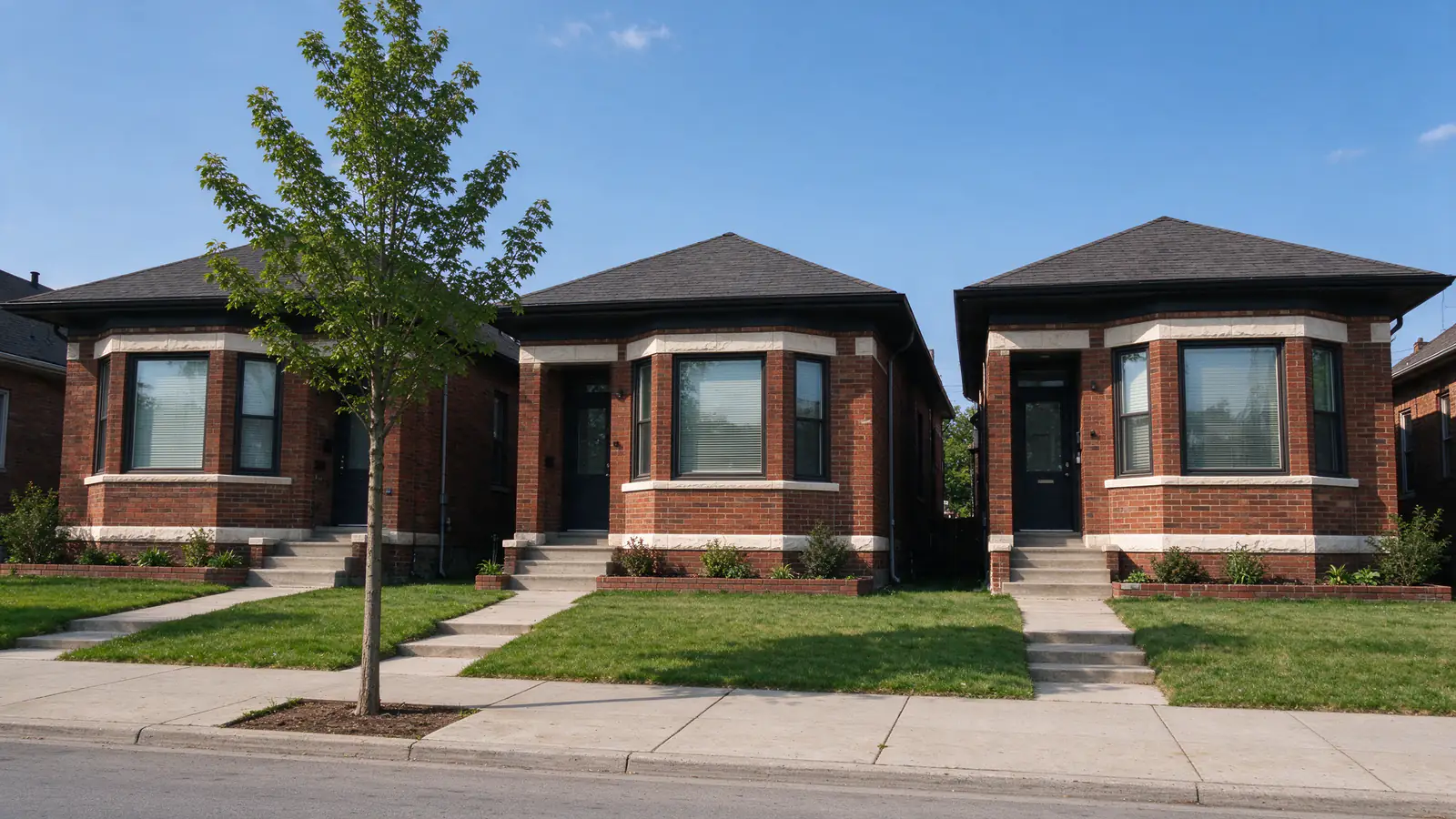
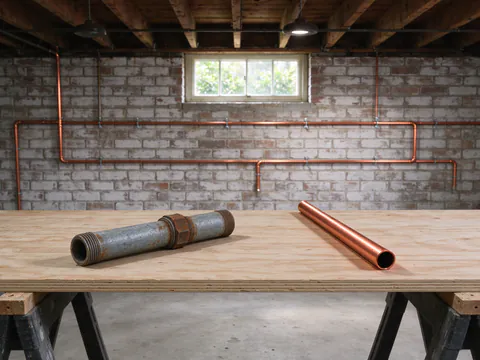
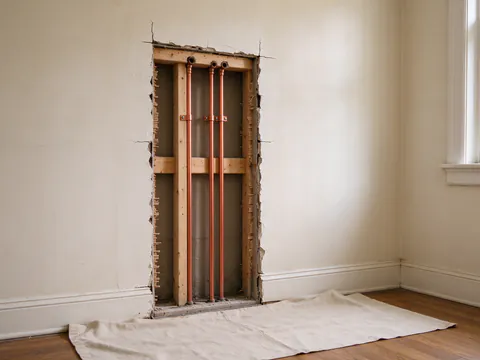
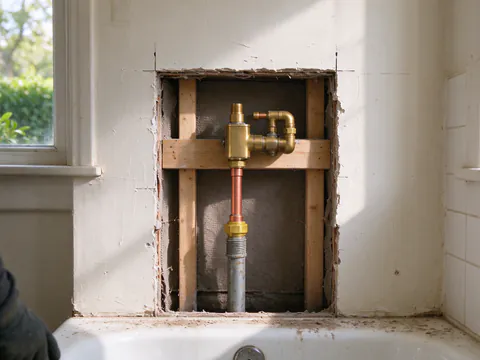
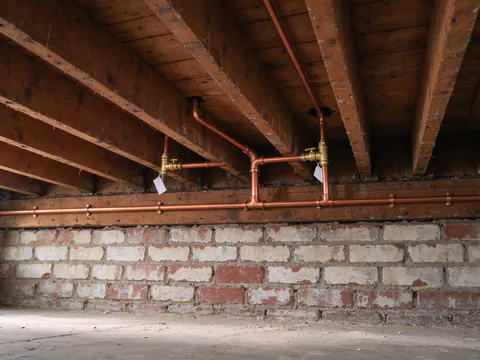
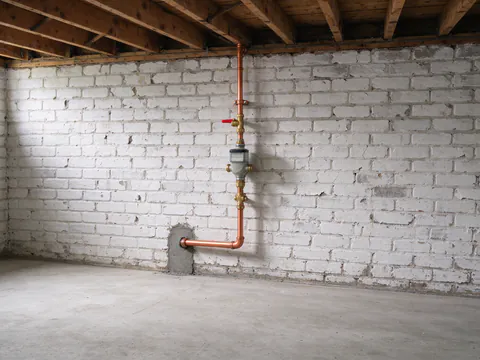
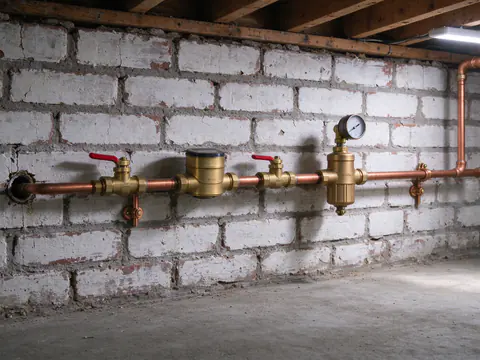
An Auburn Gresham house that has been owned and repaired for decades may not have one kind of water pipe. Copper added during a bathroom remodel, a galvanized main nobody touched, a brass union where a leak was fixed: the supply system becomes a patchwork, and every joint between metals is a place to look before deciding what to replace.
Here that decision tends to rest with the people living in the house. Half of Auburn Gresham’s occupied homes are owner-occupied, against 46.0% citywide, and Chicago Lake Repiping works with those owners on galvanized pipe replacement, whole-house repiping and lead service line replacement, offering and managing the work, which is done by licensed and insured plumbing contractors holding the City of Chicago plumbing license.
A house that is half copper already
Galvanized steel supply pipe corrodes from the inside. Rust and scale build on the wall, the bore narrows, and flow fades at the fixtures furthest from the meter before anything leaks. When a section fails, the quickest fix is to cut it out and put copper in its place, and over the years that leaves a house with copper in some rooms and steel in others.
Two things follow. First, the joints. Copper and galvanized steel are different metals, and where they touch in water, the steel side can corrode faster. A brass fitting or a dielectric union between them slows that; a direct joint does not. Second, the steel that stays. Replacing the section that leaked does nothing for the main or the branch beside it, which are the same age and narrowing at the same pace. A partial repipe is a real option when the remaining steel is limited and sound, but it should be written as partial, with the boundary and every transition named.
The City’s permit records here show both kinds of work. A 2020 permit for an Auburn Gresham single-family house replaced “all piping and supply from galvanized to copper” along with the shutoff valves. A 2021 permit for a three-unit building replaced the galvanized supply lines together with the drains, and a more recent Express permit took a fire-damaged house from galvanized to copper during its rebuild. Fire, water or a long vacancy can force the decision; otherwise the owner sets the timing, and that is the advantage of looking before a leak does it for you. The guide to identifying your water pipes shows how to tell the metals apart at a glance: galvanized is dull gray, threaded and magnetic; copper is reddish brown.
Owner-occupied, owner-done? What Chicago allows
Chicago’s licensing rules have one exception that matters in a neighborhood where 43.0% of housing units are detached houses. The owner, occupant or lessee of a detached single-family home may do their own plumbing, to code and inspected, filing the Express permit with Form 401 and ID. That owner may not hire anyone else except a licensed plumbing contractor, and the moment the building is a two-flat, the exception ends: 32.8% of Auburn Gresham’s units sit in buildings of two to four units, and those need a Chicago-licensed plumbing contractor listed on the permit.
The material is not a choice either way. Inside the city, the Chicago Plumbing Code lists copper, brass and galvanized steel for water distribution, with no entry for PEX. Since the 2021 amendments, copper can be soldered with lead-free solder, brazed, press-connected or joined with push-fit fittings, and parts that carry drinking water must meet NSF 372, a weighted average lead content of 0.25% or less. The who can repipe guide covers the licensing rules in full.
Auburn Gresham’s housing and permit record
The housing sits in the middle of Chicago’s age range. The median year built is 1949, against 1953 citywide, and 38.9% of units predate 1940, close to the city’s 38.8%, in American Community Survey data compiled by the Chicago Metropolitan Agency for Planning. Of 20,195 housing units, only 8.1% are in buildings of 20 or more units. Houses of that period can have steel supply pipe, early copper or a mix, and the basement shows which; age alone does not.
Since January 2019, 26 City permits for Auburn Gresham addresses spell out the replacement of water supply piping, about 13 per 10,000 housing units. Since the Express Permit Program launched in late 2023, 43 plumbing permits here include repair or replacement of piping, about 21 per 10,000 units, among the ten highest rates in the city, and 9 include risers in existing chases. Permit counts record permitted work, not how many houses need it. Engine Company 129 on Ashland Avenue, a designated Chicago Landmark, and almost all of the community area fall within ZIP code 60620.
Mixed pipe in an Auburn Gresham house?
Get every transition mapped from the meter and main shutoff before deciding what stays.
Pairing the repipe with the lead line
Under Lead-Safe Chicago’s guidance, a house or two-flat built before 1986 probably has a lead service line unless someone replaced it during a renovation or addition. The City’s Equity program offers a free full replacement to income-qualified owner-occupants below 80% of area median income; the Homeowner-Initiated program waives the permit fees when the owner hires a contractor for the full line, and the City connects it to the main. Either way the new copper stops at the basement wall, so the interior piping is planned separately. When the service line is done first, the repipe ties into a new line and a sound shutoff; see repiping after lead service line replacement.
How the walk-through reads a mixed system
It starts where the service line enters, at the meter and main shutoff. Static pressure is read at a hose bibb, and flow is compared at the lowest and highest fixtures, because a weak second floor can come from the service line or a valve as well as the pipe. Then each transition between metals is found and noted, with the fitting used. The quote that follows says what is replaced, where old pipe stays, which walls are opened in clean rectangles at fittings and turns, who closes them, and when the water is off. After the cutover, the new piping is flushed and aerators and screens are cleaned, since loosened scale from the old steel can catch there. The galvanized pipes guide goes deeper on the symptoms.