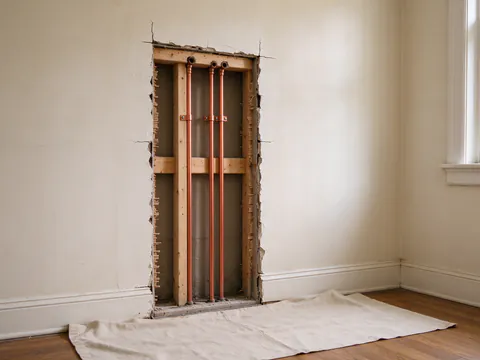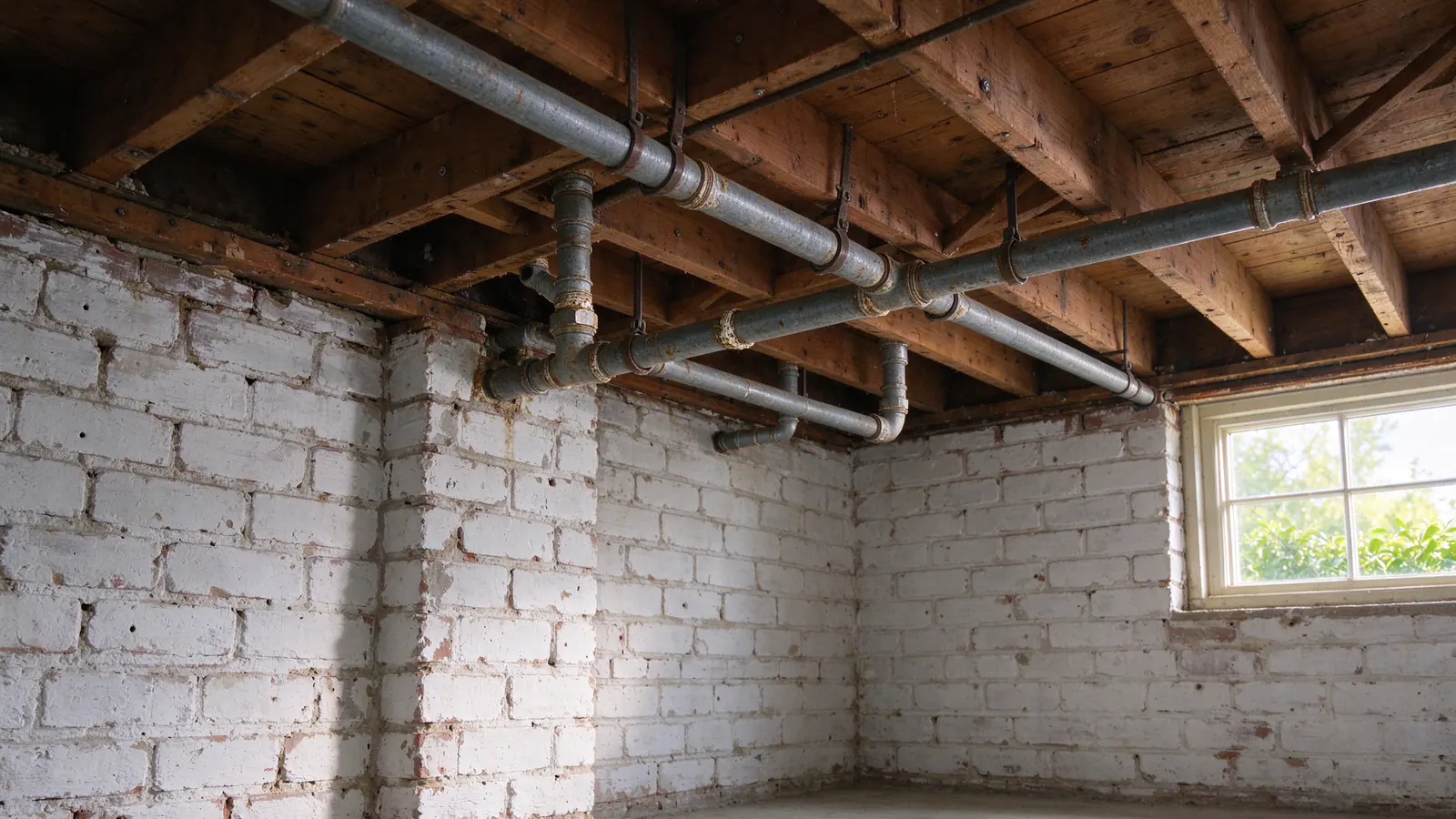
Whether repiping is worth it depends on the pipe’s condition and your plans for the house, not on its age. Galvanized steel supply pipe corrodes from the inside along its whole length, so in an older Chicago home it is a cost to plan for. For a buyer, the question is how to turn an inspection note into a number before closing. For a seller, it is whether to do the work, price it, or leave it to the buyer.
Chicago Lake Repiping offers and manages whole-house repiping and galvanized pipe replacement across Chicago and nearby Cook County suburbs, with the work done by licensed and insured plumbing contractors. This guide covers how to weigh the decision at the two moments it comes up most sharply: buying and selling.
What a home inspection can and can’t tell you
A home inspector looks at the pipe from the outside. They can see that the supply piping is galvanized steel, note threaded joints, rust at fittings, past repairs in copper, and run a few fixtures. What they cannot see is how much of the inside of the pipe has closed up with rust and scale, because galvanized pipe can look sound outside while its bore has narrowed inside. Homeowners report inspection notes along the lines of “galvanized, no leaks, but a matter of time,” which is accurate and not much help with a budget.
The inspection is still useful. It tells you where to look next. If the report notes low pressure in the basement, brown water at a tap or a recent leak, the next step is a plumber’s visit while you still have time to act on it.
The four things to measure before closing
Ask that visit to record four things:
- The service line material where it comes through the basement wall. Lead-Safe Chicago says a house or two-flat built before 1986 has a high likelihood of a lead service line unless it was replaced. That is a separate project from the interior piping, with its own programs; see lead service line replacement.
- Static pressure, read at a hose bibb with nothing running.
- Flow at the top floor with another fixture open. Good static pressure with weak flow upstairs points at the interior pipe.
- A written scope for replacing the supply piping: what is replaced, the material, the main shutoff, the openings listed room by room and who closes them, and the permit.
With those four, an inspection note becomes something you can weigh. The guide to identifying your water pipes helps check the material yourself before the visit, and the low water pressure guide explains the readings.
Weighing it: what pushes toward a repipe now
| Evidence | What it suggests |
|---|---|
| Weak flow on the top floor when another tap runs, with good static pressure | The interior pipe has narrowed. A repipe addresses this. |
| Brown first draw at certain taps that returns after the water sits | Corroding pipe feeding those fixtures; see the rusty water guide |
| Leaks at threaded joints, or several past repairs | The system is failing at its weakest points |
| A remodel that will open walls anyway | The cheapest moment to replace the pipe behind them |
| Copper throughout, good flow, no leak history | Little case for a repipe now |
| Galvanized with good flow and clean water | A judgment call: plan for it, and watch flow and water color |
Homeowners get conflicting advice on that last row. One side says replace galvanized before it fails, to avoid a leak inside a finished wall and an urgent job on someone else’s schedule. The other says do not spend money on pipe that still performs. Both have a point. What settles it for a specific house is evidence: flow, water color and the condition of the joints, rechecked over time.
The scope options
Spot repair. Fixes one failure with a local cause. On galvanized it leaves the rest of the old pipe in service, and homeowners report that plumbers are reluctant to warranty small fixes on it.
Partial repipe. A partial repipe replaces one defined part: one bathroom, one riser, the hot side, or the part of the house a remodel opens. The quote should say where new pipe ends and old pipe stays.
Whole-house repipe. Replaces all the supply piping from the main shutoff, in one permit and one set of openings. It costs more up front and leaves no old supply pipe in service.
Pipe lining comes up as a fourth option; the repipe versus pipe lining guide covers the questions to ask before choosing it.
Under contract on an older house?
A walk-through from the meter gives you a written scope and price to weigh before the inspection period ends.
If you’re buying
Price the work before you close, not after. With the four measurements and a written scope, you can decide whether to ask the seller for a credit, plan the repipe after closing, or walk away. Homeowners report asking sellers for credits on galvanized pipe; a credit request carries more weight with a scope and price behind it than with an inspection note alone.
Plan the timing too. If you are moving in, a repipe in an empty house is simpler than one around furniture and a household, though staying home through a repipe is possible because the water is off only during cutovers; see living through a repipe. If the house also needs a new lead service line, plan the two together, because the new service line decides where the main shutoff and meter sit.
Ask your insurer about the plumbing before you buy. Homeowners report insurers asking about older plumbing, surcharging it or declining a policy over galvanized supply pipe. Practices differ between insurers, so ask yours directly what it asks about supply piping.
If you’re selling
There are three honest paths, and none of them guarantees a sale price.
- Repipe before listing. The work is done under a City permit, and the inspection result is posted online, so a buyer’s inspector can see it was permitted and inspected. It takes time and disruption before the sale, and the buyer gets new pipe they did not choose.
- Get a written scope and price. A buyer can plan the work with real numbers instead of guessing from an inspection note.
- Sell as-is. The buyer’s inspection will likely note the galvanized pipe, and the buyer decides what to do with it.
What it costs
A typical Chicago-area range for a single-family whole-house repipe is $5,000 to $15,000+, with fully finished two- and three-story homes running higher. A two-flat runs $8,000 to $18,000+ for the whole building; see the two-flat cost guide. The City’s Express plumbing permit adds $150 per dwelling unit. Restoration of wall openings is the part with no public figure, so it is the line to read most closely. The Chicago repipe cost guide breaks the price down.
No City, state or federal program was found that pays toward interior repiping. Chicago’s lead service line programs bring a new line to the house and stop there.
Where to start
If you are inside an inspection period, book the plumbing visit now and ask for the four measurements in writing. If you are planning a sale, start with the same visit, then choose a path. The do I need a repipe tool and the repipe cost estimator give a first read, and a call to the number on this page sets up a walk-through. The cornerstone guide to galvanized pipes in Chicago homes covers the full background.