There is no universal winner between PEX and copper for a repipe, and inside the City of Chicago there is no choice: the plumbing code lists copper, not PEX, for water distribution. In suburbs that follow the Illinois Plumbing Code, such as Oak Park and Skokie, both are allowed, and the right pipe depends on the route through the house, the joints, exposure to cold and sunlight, and budget.
Chicago Lake Repiping offers and manages copper repiping throughout Chicago and PEX repiping in suburbs whose code allows it, with licensed and insured plumbing contractors doing the work. This guide compares the two pipes on the questions that actually change a repipe, rather than on slogans from either side.
Where each pipe is allowed around Chicago
Before comparing pipes, settle whether the comparison applies to your address. The code that governs the building decides it:
| Where the building is | Copper | PEX |
|---|---|---|
| City of Chicago | Listed (Types K, L, M) | Not listed for water distribution |
| Oak Park, Skokie, unincorporated Cook County | Listed | Listed in the Illinois Plumbing Code |
| Evanston | Required; Type L minimum above grade | Not listed in the City’s ordinance |
| Park Ridge | Required; Type L above ground | Banned for water distribution |
| River Forest | Listed | Residential, above grade, covered by at least 5/8 inch drywall or equivalent |
Each village’s rule is confirmed for the specific address before work starts. The guide to whether PEX is allowed in Chicago explains the City’s table and the recent code changes that left it alone.
How each one is installed
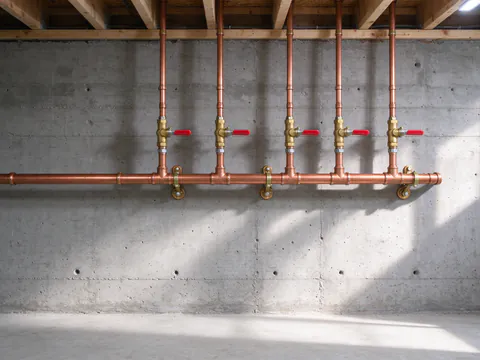
Copper is rigid pipe, cut to length and joined at every change of direction. Chicago’s code, since its 2021 amendments, allows lead-free soldering, brazing, press-connect fittings made with a tool the fitting maker certifies, threaded and mechanical joints, and listed push-fit fittings. A copper system is laid out trunk and branch: larger mains in the basement, smaller branches to each fixture group. Because it cannot bend around obstacles, a copper route through an old house needs a clear path, which in a plaster-walled house means planned openings at the turns and fittings. Press fittings make each of those joints without an open flame.
PEX is flexible tubing that bends around gentle curves, so a long run can go from basement to bathroom with few or no fittings in the wall. It can be laid out trunk and branch like copper, or as home runs from a manifold, with one line per fixture. Joints use crimp, clamp or expansion fittings listed for the tubing. The tubing has a minimum bend radius, needs support at set intervals, and must be protected where it passes through metal studs or sharp edges.
That flexibility is the main reason PEX can need fewer wall openings in a finished house. It is not a guarantee: the tubing still has to reach each fixture, and connections still sit at the valves, the manifold and the water heater. The plaster walls guide covers how openings get planned with either pipe.
What each material is sensitive to
No pipe is indestructible, and the honest comparison is about which weaknesses matter in your house.
Copper responds to water chemistry, flow velocity, workmanship and stray electrical current. Aggressive water or high velocity can thin the wall from the inside and cause pinhole leaks; flux left in a joint can start corrosion at that spot. Chicago and the suburbs that buy its Lake Michigan water receive corrosion control treatment that the City says coats the inside of pipes to help keep metals from dissolving into the water, which works in copper’s favor. Evanston and Skokie get their water from Evanston’s own treatment plant. The copper pinhole leaks guide explains the causes without pretending there is only one.
PEX has its own limits. It degrades in ultraviolet light, so it cannot run exposed to sun, and it must be kept away from heat sources such as water heater flues within the distances the maker’s instructions set. Fittings are the weak points of a PEX system, so the brand of tubing, the matching fitting system and the installer’s crimping or expansion work matter. Homeowners who remember early plastic pipe failures sometimes lump PEX in with them; replies in a Chicago-suburbs forum thread suggest the trouble being remembered belonged to CPVC, and that installer skill decides a great deal. Copper lasts a long time, but it does not last forever either.
Freezing, exposure and the Chicago winter
Chicago O’Hare averages about 121 days a year with a low at or below freezing, and 6.5 days a year with a low at or below zero, by NOAA’s 1991 to 2020 climate normals. Pipe that runs in an exterior wall, an unheated porch or a cold crawl space is exposed every one of those nights.
PEX tolerates a freeze somewhat better than copper, because the tubing can stretch slightly as ice forms. That is a margin, not a protection. A frozen PEX line can still split at a fitting, and a fitting failure inside a wall floods just as much as a split copper pipe. Chicago’s code requires that pipes exposed to low temperatures be protected from freezing, and the better repipe decision with either material is a route that keeps supply lines inside the heated part of the house. The winter post on old pipes goes further into cold spots.
Is PEX safe for drinking water?
Homeowners ask whether PEX leaches chemicals into drinking water. The answer that holds up is narrow. The Illinois Plumbing Code approves cross-linked polyethylene distribution systems made to ASTM F876 and F877 and AWWA C904, with listed fitting systems, and drinking-water pipe and fittings carry listings that test what they release against limits. A listing is a test against a threshold, not a statement that nothing at all enters the water.
If that residual uncertainty is the deciding factor for your household, copper avoids it. Inside Chicago, Evanston and Park Ridge the point is moot, because the code already calls for copper.
Cost: what changes and what does not
PEX tubing costs less than copper as a material, and the gap has been widening: the federal producer price index for copper and brass mill shapes rose about 30% over one recent year, against roughly 5% for plastic construction products. Flexible tubing also tends to need fewer fittings and fewer wall openings, which saves labor and restoration.
Material is only part of a repipe. Labor, access through finished walls, the permit, the main shutoff, the water heater connections and patching all stay. A PEX repipe in Oak Park and a copper repipe of a similar house in Chicago are both priced against the same typical Chicago-area range for a single-family whole-house repipe, $5,000 to $15,000+, with the material moving a job within it rather than into a different range. The Chicago repipe cost guide breaks the price down part by part.
Choosing between PEX and copper?
A walk-through confirms what your village allows and how each pipe would route through your walls.
How to decide where both are allowed
| Question | Leans toward PEX | Leans toward copper |
|---|---|---|
| Finished plaster and tile in the route | Fewer openings where tubing can snake through | Openings at each turn; press fittings keep them flame-free |
| Exposed runs in a basement or utility room | Needs protection from light and damage | Holds up exposed and looks finished |
| Near the water heater | Must respect heat clearances; copper can bridge this section | Connects directly |
| Pipe through cold spaces | Some tolerance to freezing, but fittings still fail | Splits if frozen; insulation and routing matter either way |
| Budget pressure | Lower material cost, fewer fittings | Higher material cost |
| Concern about plastic in drinking water | Listings test against limits | Avoids the question |
| Contractor willingness | Homeowners report some suburban plumbers declining PEX even where allowed | Every licensed contractor works in copper |
Ask the contractor to name the pipe type (copper Type L or M; PEX-A or PEX-B with its fitting system), the layout (trunk and branch or manifold), where any transitions sit, and how the route stays out of cold spaces. A quote that only says “repipe in PEX” or “repipe in copper” leaves out the parts that decide how the system performs.
Where to go from here
If your building is inside Chicago, the next step is planning a copper route through the house; the whole-house repiping page covers the full job and the galvanized pipe guide explains what is being replaced. If you are in a suburb, confirm what your village lists, then weigh the table above against your walls. Call the number on this page or use the estimate form for a walk-through that measures pressure at the meter and maps both routes.